
The Iran War might be the first international conflict where the narratives have largely been shaped by AI-written geopolitical analysis. Putting aside the issue of visual misinformation, AI-generated analytical content on the war appears to have exceeded the median human outlet’s capabilities.
Unfortunately, this is primarily because the vast majority of geopolitics writing coming out of pundits and think tanks was already meaningless drivel designed to (1) sound plausible while (2) alarming or reassuring the reader. As you can imagine, that makes it the perfect domain for artificial intelligence’s blooming long-form writing abilities.
While the BS Detector might have a few readers who are genuinely experts in understanding the course of the conflict in Iran, I’d guess that the vast majority of you are not. More likely, many you are avid news readers who have a deep enough understanding to be able to impress people at a party with your mastery of the history of recent events in the Middle East. You can wax poetic about the structure of the IRGC and US military assets in the Strait of Hormuz, and that’s neat! But you shouldn’t necessarily trust yourself to be able to distinguish truth from fiction in plausible-sounding deep dives into the Iran conflict any more than you should trust yourself to judge the accuracy of an AI-written proof of the Riemann Hypothesis.
Most people subconsciously like to have their priors confirmed. If you think that the Iranian regime is brutally evil, and that the US’s attempts at regime change are chugging along well, then an analyst report on how Iranian missile production has been completely destroyed will sound compelling to you.
But if you’re of the opinion that the war is an expensive debacle, then a report detailing how the US is running out of interceptor missiles at an alarming rate will be more convincing.
If you’ve been on Twitter or Substack for the last month, you’ve likely seen some posts by Shanaka Anslem Perera, an independent researcher who now has a quarter of a million followers. This tweet, for example, has a million views, and the accompanying substack article, “The Nitrogen Trap,” has almost 500 likes. These are bonkers numbers for a niche analysis of fertilizer transiting the Strait of Hormuz.


The tweet is entirely AI generated, so is the article, and so is basically everything Perera writes. If you’re attuned to recognizing AI-generated text, this stuff kind of pops off the page, but if there’s any doubt, here’s a Pangram analysis of the first 1000 words of the article:
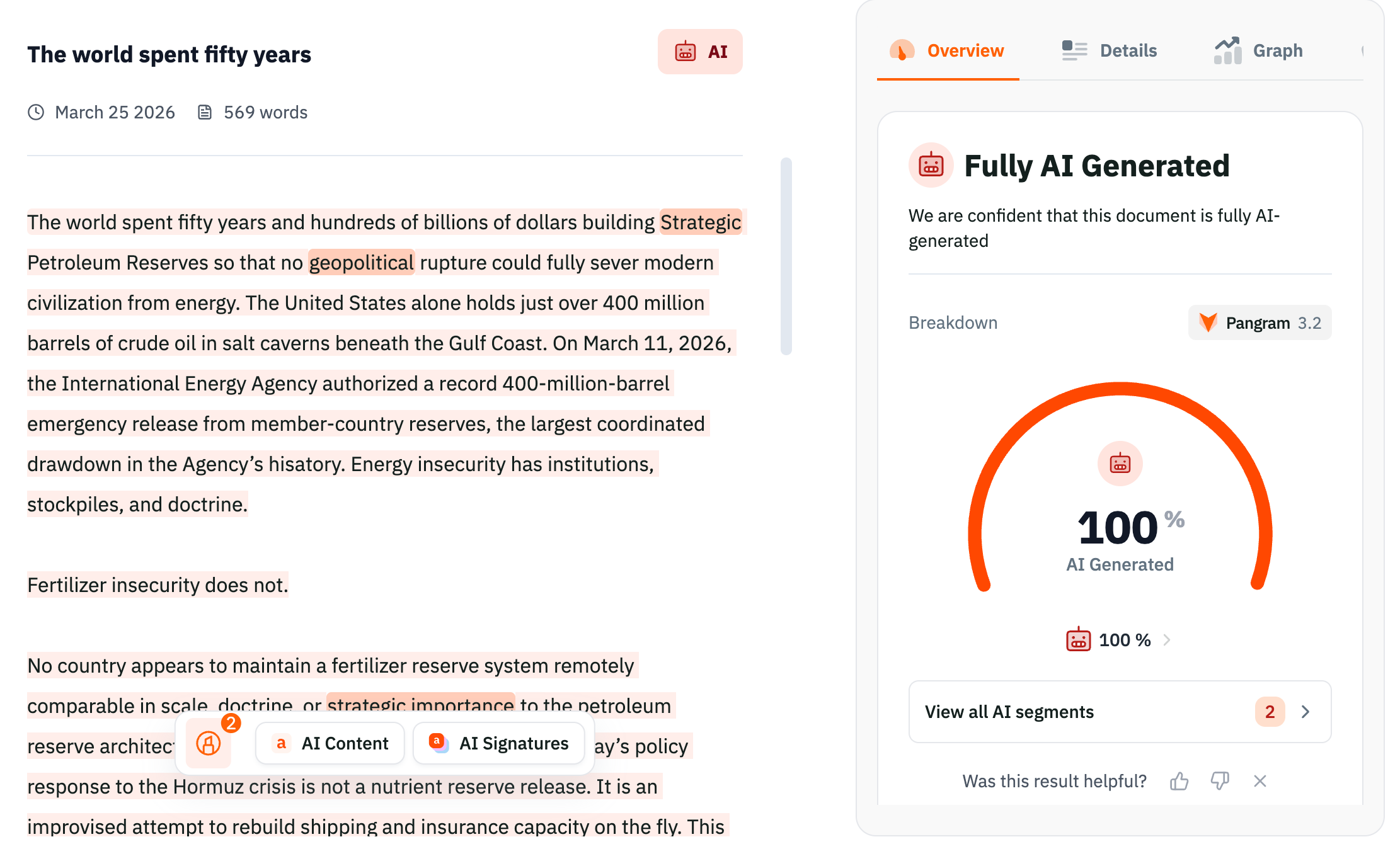
You should absolutely not trust most AI detectors farther than you can throw them. Pangram in particular, however, is pretty good and designed to avoid false positives at the expense of having more false negatives, so when Pangram says that a piece of text is AI-generated, that’s decent evidence in my view. On top of that, c’mon… this article just does not pass the eye test. It contains dozens of “It’s not just ____, it’s _____”-type constructions. I counted like 20 and then gave up a third of the way through the article. The section headers are all cartoonishly AI-generated:
I. The Invisible Architecture: How Natural Gas Became the Foundation of Human Calories
II. The Architectural Fracture: How Insurance, Not Missiles, Sealed the Strait
III. The Clock That Cannot Be Stopped: Biological Deadlines in a Geopolitical Vacuum
IV. The Quadratic Cliff: Why Linear Models Guarantee Institutional Surprise
the rest are all like this, I promise
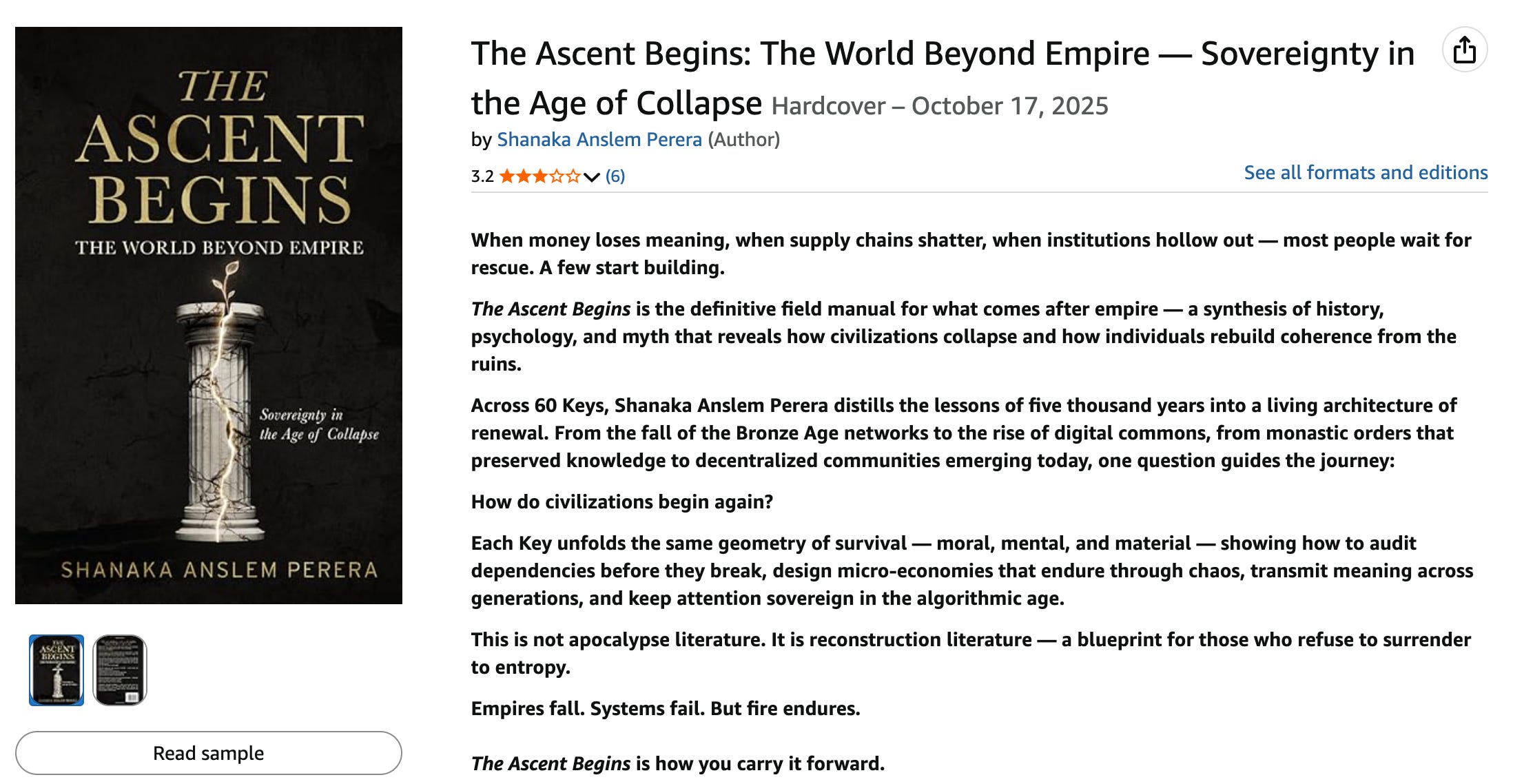
And basically all of the stuff this guy writes is similar. Relatedly, he has a book on Amazon which is more of the same slop, arguing that the bronze age collapse is analogous to the US’s high national debt (lol):
It’s possible Perera has some good ideas, as he’s maintained a large following with timely articles. But it’s hard to know for sure, since any original insights are buried under mountains of text that he exerted very little creative control over. If his recent Substack post came across your timeline, the general idea that fertilizer shipments are being blocked and that this will lead to reduced farming yields this season seems eminently plausible. But it’s impossible to know whether the alarmism in the article is warranted, since it could have been generated from a prompt to Claude Code like: “Write me a 5000-word article on how fertilizer shipments through the Strait of Hormuz being blocked will lead to a global food crisis. Be extremely rigorous in your research, spin off subagents to write each section of the article, and make sure it’s compelling to the median Substack reader.”
You could just as easily have prompted a 5000-word article with the opposite argument: that farmers will have workarounds and our resilient global economy is likely to not notice marginally reduced yields in the Northern hemisphere, except for grain prices being raised this summer by a few cents. Would that argument be true? Who knows, but it’s just as easy for AI to argue for that.
In case you think that AI-generated geopolitical analysis is a unique phenomenon to undiscerning Substack readers, I have news for you. Here is a brief from RUSI, the “world’s oldest defense and security think tank, founded in 1831 by the first Duke of Wellington.” The document, which I encountered in a Metaculus comment section, also set off my personal red flags for AI-generated content, and sure enough…
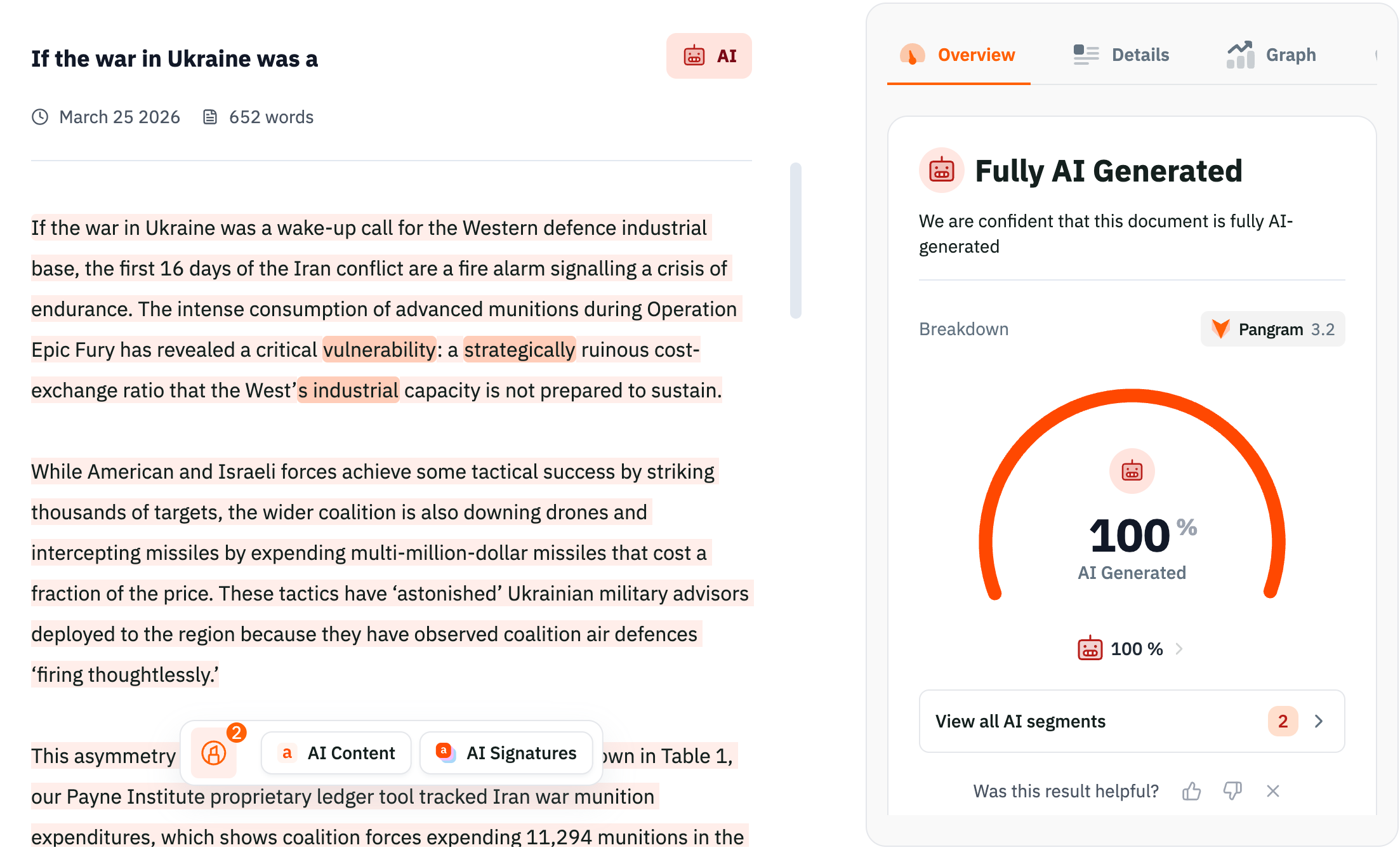
I’d argue this kind of stuff is barely better than pure misinformation. It could be true. But it could also not be, and since it’s written through some amalgamation of all the geopolitical analysis on the Internet, as funneled through Claude or ChatGPT, it’s probably about as good as the median journalist, which is to say… it’s fine. Not what you are looking for out of a serious defense think tank like RUSI.
In particular, this commentary piece from RUSI is persuasive because it starts with a true assertion about the asymmetrical nature of the US (+ allies) shooting down cheap armaments with expensive interceptors. But you could once again imagine an AI making the opposite argument. In fact, I’ll do it without the use of AI:
All warfare the US and allies have conducted in the post-war period has been dramatically asymmetrical, and yet US military hegemony has survived countless conflicts.
While the interceptors the US expends are indeed expensive, it’s perhaps advantageous to expend our older stockpiles so that they’re replenished over the next few years with cheaper and more capable models, boosting US defense capabilities for the next conflict.
The US is also learning from the first couple weeks of the conflict, making it more capable of triaging interceptions in a more critical conflict in the future.
US stockpiles are quite possibly much higher than the public numbers in the Payne Institute’s analysis, since the Payne Institute only has public information, which sets a floor on these stockpiles, not a ceiling. Also, the Payne Institute is notably biased in its assessment due to its focus on critical minerals and a framework of scarcity.
These arguments may or may not convince you, but it’s ultimately not that important, since if I used Claude to generate a 5000-word report from these arguments, it would do a much better job than I could do in the 60 seconds it took me to write those down, and it would be aimed at an audience of people who are already inclined to support those views.
A lot of commentators have recently remarked that they’ve lost faith in the epistemic benefits of debate after seeing how trivial it is for AI to write vast amounts of persuasive arguments in favor of literally any thesis. I’ve more or less agreed with this since participating in high school speech and debate, where 16-year olds, rather than AI, are set loose to write vast amounts of (slightly less) persuasive arguments in favor of literally any thesis.
What is to be done about this? Ummm, maybe more widespread AI-checkers for the time being, but at some point, it will probably be genuinely indistinguishable. Also, most people just don’t care, because they’re not that interested in knowing whether what they’re reading is true, as long as it’s persuasive and supports their ideology about the world.
I continue to shill for forecasting platforms, including prediction markets, because at the very least, people are putting their reputation or currency on the line, when predicting an event. These kinds of approaches reward accuracy, rather than persuasive ability.
This market graph, for example, provides a lot more value than a long report from a UK-based think tank on how the collapse of Iran’s regime is imminent/never going to happen/has already happened/might happen if only we were to do X.

It also strikes me as a much better use of the average geopolitics-enjoyer’s time to go and bet fake currency on markets like the one above (including ones about more fine-grained scenarios) than to engage in endless back-and-forths online, so that’s my recommendation to you, the reader!
After I finished writing this piece, I googled Perera one more time, and I noticed that he is putting out preprints on academia.edu at “the intersection of quantum foundations, measurement theory, and ontology.” He recently put out a “Modular-CM Proof of the Gourevitch Identity for 1/pi squared.” Riiiiiiight.
Geopolitics slop is an old genre, and it is mostly human produced. The uncreative types are your analysts at think tanks in DC, London, and Brussels. They don't really care about the quality of their content as much as the political message of the party/country/ideology that they are pushing. Then there are the creative types who can spin their slop into 'thought-leader' territory. Ian Bremmer is a prime example. Even Henry Kissinger, who is the so-called geopolitical genius of the last century, has produced absolute self-aggrandizing slop. So, people like Perera, that depend on AI for their slop creation are nothing new.
As for the benefit of prediction markets over this slop, I am not so sure. What do they know? They are aggregating the same Trump truths that everyone else is reading, the same anonymous sourced reporting by WSJ/NYT and straight from Israel/Whitehouse telegraphs by Barak Ravid.
Also, the average geopolitics enjoyer won't go to prediction markets exclusively, these will stay on X. They are addicted to the information flow (OSINT videos, Nick Fuentes/Mearsheimer/ [insert your favorite newsfluencer] clips, BREAKING by Walter Bloomberg and Zerohedge). Polymarket is just one more item in the news Buffet. It won't replace the entire thing.
Fun fact: the top comment on that article is also 650 words of fully AI-generated slop (100% according to Pangram). This not only suggests that the phenomenon is widespread, but that it's also likely feeding on itself. AI is writing, AI is replying. In the best-case scenario, AI is summarizing. One starts wondering how many of those 500+ likes are from actual human beings who actually read the whole 5k words on fertilizers.
It's also worrying that there appears to be no effort at all to hide the extensive use of AI. Spending a few minutes fixing a couple of red flags here and there and rephrasing a few sentences would have improved things just enough to avoid it being labelled as fully AI-generated with high confidence. This carelessness suggests there's currently no perceived risk in flooding the internet with AI slop.