
Government-Funded Alchemy
Examining Marathon Fusion's "Scalable Chrysopoeia"
1. Out of Stealth
If you went to Marathon Fusion’s website before this week, you would have been greeted with a very normal home page for a fusion startup. They were—and perhaps still are—building “fuel processing technology.” Since I’m no plasma physicist, in extremely basic terms, this is what they, and many others, were trying to do:
Fusion reactors involve combining two isotopes of hydrogen: deuterium (plentiful) with tritium (very rare). These combine, producing (1) helium, (2) a neutron, and (3) a lot of energy. The energy is kind of the point. People want to make power plants.
You can then have some of your neutrons (perhaps after using other materials to multiply these high-energy neutrons into more plentiful lower-energy neutrons) react with lithium. This can happen in lithium “breeding blankets” lining the reactor. Apart from sounding cool, this produces tritium, hopefully at the same rate as you use it up, which makes the process sustainable.
You also have to design methods to recycle the unused tritium from your spent fuel. In the case of Marathon Fusion, from the extremely brief blurb on ARPA-E’s website, they were initially developing an apparatus to test processes to recycle tritium using “metal foil pumps.” They then appear to have expanded their scope to actually developing these tritium recycling methods, as they appeared on a list of grantees under a different ARPA-E funding source for an amount about 8x higher.
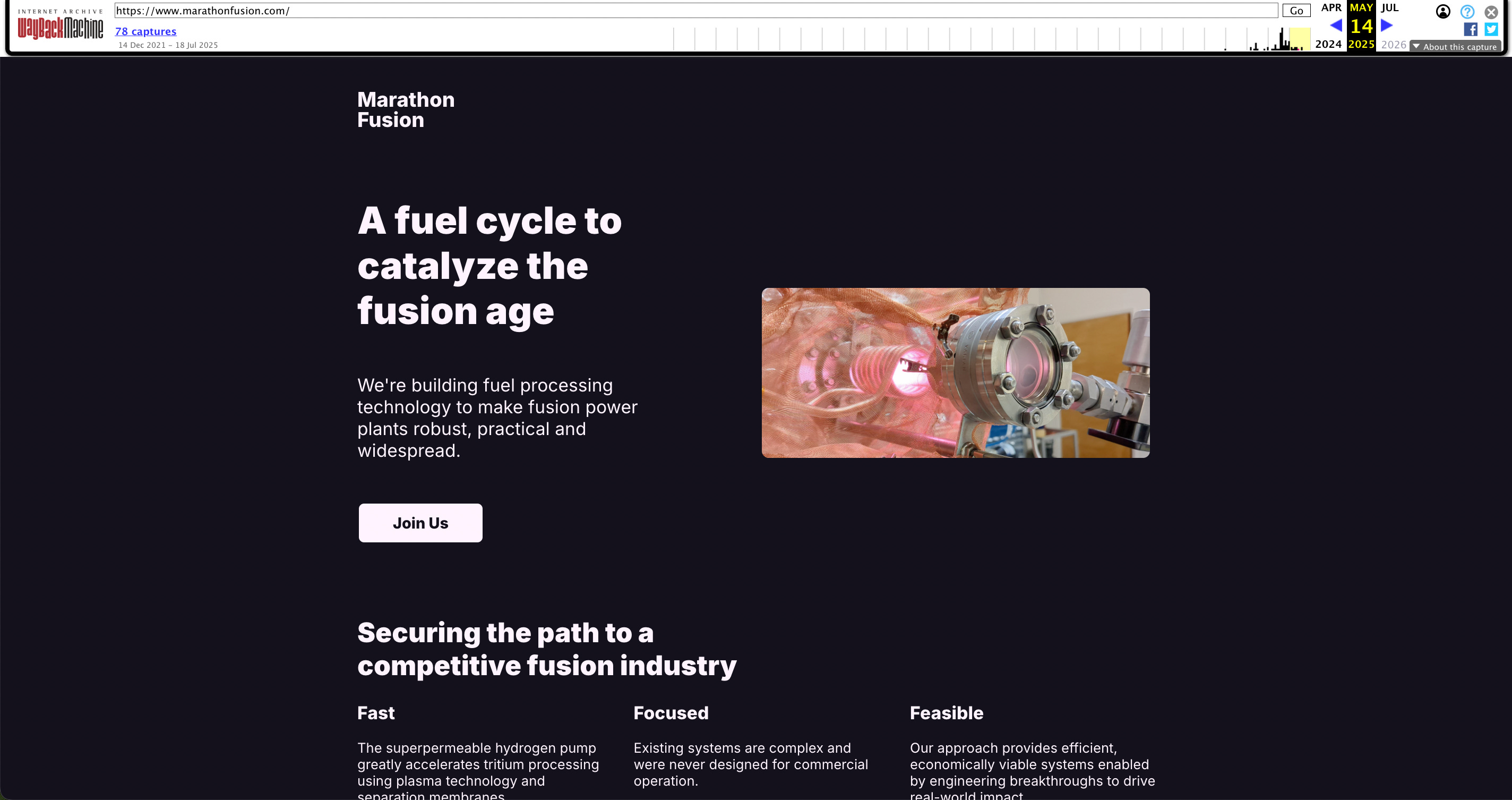
Now, a testing apparatus to prototype tritium recycling filters for fusion reactors is pretty neat, and it’s the kind of thing that gets you $450k from ARPA-E to work on. And building the technology to efficiently manage tritium, one of a handful of the most critical bottlenecks for fusion energy, will get you several million dollars of funding from venture capital. However, what’s far more exciting is the alchemical production of gold, known to the ancients as “chrysopoeia.”
Marathon’s new website, as they come out of stealth, drops a preprint called “Scalable Chrysopoeia via (n, 2n) Reactions Driven by Deuterium-Tritium Fusion Neutrons.” They also announced this with their first tweet (or perhaps just a recently cleaned slate) on an account they created last July.
In this preprint, they claim that, given a fusion reactor, one can produce large quantities of gold by using mercury as a neutron multiplying layer in the breeding blanket. Mercury-198 takes in a high-energy neutron, two neutrons are knocked out, yielding more neutrons to produce tritium from lithium, and an unstable mercury-197 that quickly decays to… gold.
2. All that is Gold does not Glitter
Would it work? I can think of several angles for evaluating the feasibility of this approach. (Skip this section if you instead want to pretend that this will work perfectly and start salivating over a fusion gold rush.)
First, the researchers have a high degree of credential credibility. The lead author on the preprint, Adam Rutkowski, has a masters degree in plasma physics from Princeton. The second author, Jake Harter, is a engineering intern at Marathon who carried out the neutronic simulations. The third author, Jason Parisi, is a staff scientist at the Princeton Plasma Physics Laboratory who got a PhD in physics from Oxford. These are very much not software engineers who think they’ve solved alchemy after talking with ChatGPT for a year or something.
Second, the startup has some amount of credibility through its broad array of funding sources, including ARPA-E, the 1517 Fund, Strong Atomics, and Breakthrough Energy. However, it remains slightly unclear whether this gold production preprint is a core component of their value proposition or just a fun side project. They have a photo on their website of them showing off their pitch deck to Bill Gates, but the title slide seems to be generally about the fuel cycle of a fusion reactor, not chrysopoeia.
Third, in the preprint they emphasize several times how their process builds on past work and why they think their approach actually shows economic promise. It has been trivial since the 1980’s to produce gold alchemically, when Nobel laureate Glenn Seaborg (also of Seaborgium fame) used a particle accelerator to transmute bismuth into gold. The obvious issue here is the economics. Making a few micrograms of gold at the expense of millions of dollars isn’t appealing except as a scientific curiosity. Their breakthrough comes through a handful of key insights:
They say that the “(n, 2n) cross-section” of mercury is large enough to function as a neutron multiplier for tritium production. In layman’s terms, this means that the odds of a neutron multiplying in mercury is high enough to be synergistic with the requirements for fuel management in a fusion reactor.
Using mercury in lithium blankets can produce an economically-relevant amount of gold when you run the calculations.
The specific process they believe is feasible to implement would yield an order of magnitude higher amount of gold than previous attempts at theorizing a pathway. This makes it economically viable, rather than a curiosity.
There are a few ways that this might not pan out as the authors imagine. First among these is that fusion energy itself might not pan out. This process only works if you have a fusion reactor, obviously, and if the economics for fusion energy are negative, it’s unlikely that even some supplemental production of gold would make the economics work. Moreover, if the physics of fusion energy prove insurmountable (net + energy, structural materials in tokamak reactors, tritium sustainability, etc) then this of course won’t work either. Prediction markets seem to put the odds of commercial fusion in the next couple decades at around 50%, which I find quite reasonable. I remain cautiously optimistic that fusion energy will eventually be viable.
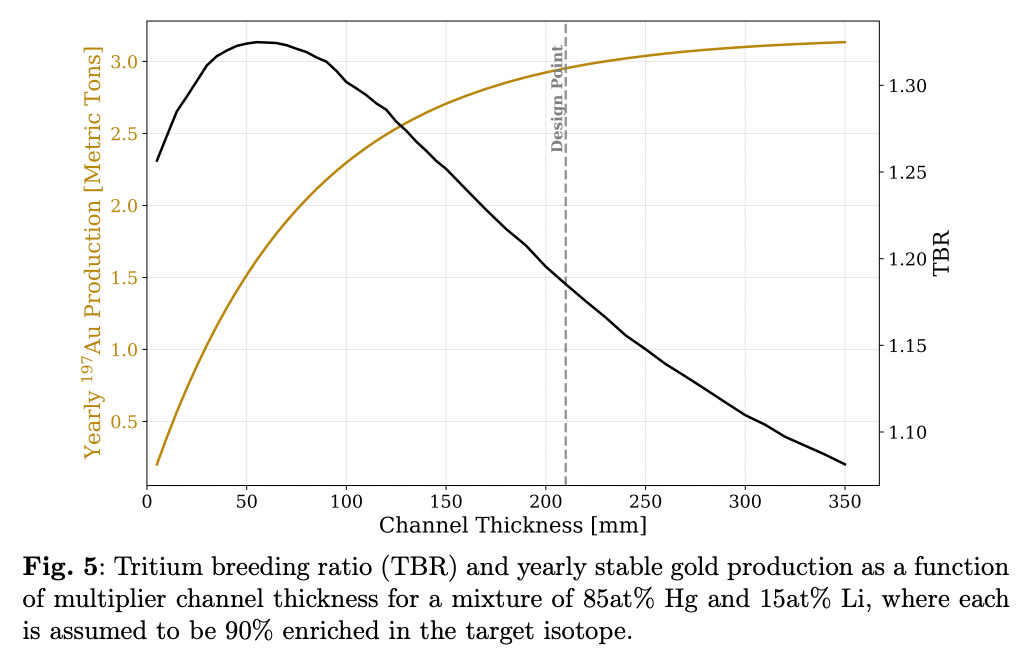
The second is that the process adds so much engineering complexity to the neutron multiplication process that it ends up posing more of a burden to the fusion plant than the value it provides in gold production. The authors seem to view this as unlikely, but it’s very possible that the design of these breeding blankets and tritium production is already so fraught that an additional engineering consideration just pushes it over into complete impracticality, making neutron yields too low or structural material considerations untenable. In the remaining 50% of worlds where fusion energy becomes commercialized, I think there’s at least a 1 in 4 chance that these additional requirements are just completely unsustainable for the power plant. So, let’s say ~15%. The graph below, for example, shows the tradeoff between tritium breeding ratio and gold production, but you could very easily imagine that if the relationship is a little different from their simulations, it could become infeasible.
The third is that the entire process is non-feasible for fundamental physics reasons. The “(n, 2n) cross-section” may be much smaller than they calculated, there might be an error in their neutronic simulations, etc. This is quite challenging for me to evaluate, but my base rates on new alchemical approaches are quite low, and we’ll learn more after their preprint goes through peer review and is looked at by smart fusion scientists and theoretical physicists around the world. I’d say there’s at least a 50% chance of this happening in worlds where fusion energy is commercialized, so another 25%.
The researchers also appear to be worried a bit about perception around the toxicity of mercury, but I think this pales in comparison to, y’know, radioactivity, and the toxicity of the irradiated beryllium-lead-lithium alloy slop that might otherwise be used in its place. I don’t think the regulatory hurdles on mercury usage are the regulatory hurdles that fusion energy producers will be worried about in the slightest.
Optimistically, in my mind this leaves about 10% odds that fusion energy becomes commercialized or at least piloted over the next couple decades and Marathon Fusion’s approach for the alchemical production of gold becomes a meaningful consideration for these fusion plants! That’s pretty high, and implies a high value for continuing to research this technology, even if not necessarily for Marathon Fusion specifically. Manifold traders are giving this proposition ~20% odds, which likely reflects the discount rate on a market that only resolves in 10 years, although it also leaves room for other potential methodologies for gold production (presumably also through fusion energy but who knows).

3. Let’s Fantasize about a Chrysopoeia Economy
Now, the preprint gives its own brief technoeconomic analysis, which you can read. Some back of the napkin math on energy values and estimated energy production of a fusion plant implies that the production of gold more or less doubles revenue. This is all much more fun that trying to wrap my head around neutron multiplication.
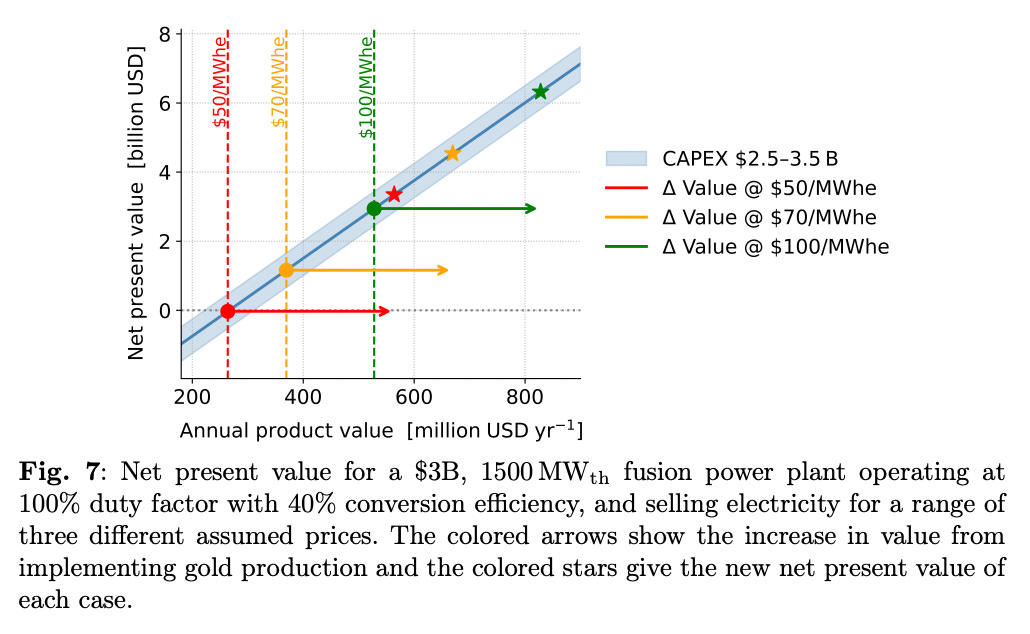
They estimate 2 tonnes of gold produced per gigawatt of thermal energy, per year. ITER (International Thermonuclear Experimental Reactor, prounced “Eater”), aiming to be finished in 2034, would produce 0.5 GWth, yielding 1 tonne of gold per year. Full-sized fusion plants would probably produce in the ballpark of 5x as much thermal energy, and therefore 5x as much gold.
Five tonnes of gold are currently worth about half a billion dollars ($100k/kg). For reference, the global volume of gold production is ~4000 tonnes. In a world where nuclear fusion generates even half the energy that nuclear fission generates today, and these fusion reactors all utilize a chrysopoeia process, that would imply an additional ~1000 tonnes of gold per year, which would (surprisingly) not completely oversaturate the gold market. Prices for gold would probably drop, but not by, say, an order of magnitude, and certainly not by the 3-4 orders of magnitude that would enable gold to, say, replace copper as a commodity metal, improving microelectronics, household wiring, etc.
However, this would seemingly—as the authors allege—provide a serious revenue source for power plants. Half a billion dollars per year is roughly equivalent to ballpark estimates of the total revenue from power sales that fusion plants could hope to get, and would likely be as important to the economics of fusion energy as synergies with nuclear weapons manufacturing was for early nuclear fission plants.
It’s kind of historically comical to me that gold, a metal which is almost entirely extrinsically valuable, could provide a revenue stream for fusion energy providers. After millennia of alchemy being a brain worm-generating, scientific red herring for generations of scientists from Hellenistic Alexandria to Isaac Newton, suddenly it could become a critical component of the future energy ecosystem of our world?
4. What are the Motivations of Marathon Fusion
Apart from the scientific and economic value of this work, I suspect that Marathon Fusion might have some other motivations. This announcement will create a pretty decent hype cycle. While this might be the first blog post about this potential breakthrough, it will almost certainly not be the last. This kind of publicity will only benefit their company. Unfortunately, their announcement was slightly over-shadowed by another significant milestone with the word “gold” in it: OpenAI’s achievement of a Gold Medal-score on the International Mathematical Olympiad.
Perhaps more importantly, the investment opportunity for a technology that could produce kilotonnes of gold and double the revenue of fusion energy is far more significant than that for one of a half dozen startups all working on the fusion fuel cycle. This could drive investment that could be put to good use in other areas that Marathon Fusion is working on. And of course, “chrysopoeia” is just an amazing word that as far as I can tell, has never been used in a physics paper. That’s a good way to make your mark as a researcher and carry on in the tradition of ancient alchemists.
5. Oh ya, this Gold is Radioactive
The researchers also write about the issue that the gold will be kind of radioactive after it’s produced. Paraphrasing from their preprint:
The gold produced has to sit for 6.8 years before it can be classified as low-level (Class-A) waste, according to the NRC.
To then not require any kind of labeling, the gold has to sit for 13.7 years.
If you want your gold to meet an even more stringent requirement (less radioactive than a banana), it should probably sit for 17.7 years.
Ultimately, gold is the kind of thing that most people are happy to let sit around in a vault for a decade, but if you were hoping that nuclear fusion would arrive soon and you’d get your hands on some fusion-chrysopoeia-produced gold to make into a cool desk cube/paperweight by the 2030’s, well, you might have to wait for another decade.
To be the first to find out when we can synthesize the Philosopher’s Stone directly from a combination of excess LLM inference tokens and superconducting qubits… like, comment, and subscribe below:
Correction 8-14-25: A previous version of this article wrongfully listed the name of one of preprint’s authors as “Adam Parisi,” but the correct name is in fact “Jason Parisi.”
The last bit is the best! Who wouldn’t want radioactive gold?
There's a new paper that covers this topic more broadly. It points out that there are medical isotopes that are much more expensive than gold which can push even today's experimental fusion reactors towards economic viability. While the market size for these is limited in a way that gold isn't, they can help create a pathway to making fusion economical much sooner.
https://arxiv.org/pdf/2512.09242
It seems a bit early to say if any of this will work, of course, but it looks very promising.