
1. War Markets Delenda Est
Of all the offerings of prediction market platforms, the most reviled by the media and general public are war markets.


Objections to these run in a number of directions. War markets might encourage insider trading and the leaking of confidential information. They might lead to people going out and influencing events in a conflict for profit. They might be morally corrosive because war is bad, betting is bad, and encouraging some unholy combination of the two is therefore uniquely bad. They represent an extreme example of a taboo tradeoff between “sacred values” (the life and death of people in a conflict zone) with the “profane” (money traded on prediction markets). That is to say, they might be icky.
As a result of all of this, there are very few people willing to defend markets on war. Even the current CFTC (Commodity Futures Trading Commission)1, which has been almost maximally open to the expansion of prediction markets, has lately shown signs that they may reign in markets on war, assassination, terrorism, etc. It has already been the case that more-regulated exchanges (read: Kalshi) cannot put out explicit markets on conflict, and will continue to be the case that less-regulated exchanges (read: Polymarket) will probably continue to do so for their non-US platforms. But the CFTC could have opened the doors to a broader set of regulated markets on war, which they appear to deliberately not be doing. This also might have had the effect of incentivizing the existing crypto markets on war to “come in from the cold” and conform to some regulatory standard. Alas.
A couple weeks ago, the CFTC issued a notice of proposed rulemaking with considerable detail on what might constitute markets on war that “go against the public interest.” Here is the section (3b) from this long and winding document that lays out their arguments as to why war markets are very likely to be against the public interest, and thus verboten. I’ve cut out a couple redundant sentences but reproduced it nearly in full because I think it’s a great summary for the most compelling arguments against war markets. If you get bored, just skip to the bottom of the quote.
The Commission preliminarily believes that event contracts involving terrorism, assassination, or war can present significant national security risks and therefore raise public interest concerns. The Commission is concerned, first, that the prices of such event contracts would not necessarily align with the actual likelihood of the underlying terrorism, assassination, or war events because the trading public is shielded as a matter of public policy from relevant information about the event. For this reason, trading in such event contracts could, at the least, present a distraction to law enforcement and military authorities and, at worst, be manipulated by wrongdoers to divert attention from planned harmful events. For example, event contracts based on whether an attack on a particular location will occur would provide an opportunity to individuals planning such an attack to buy the ‘‘no’’ contract and thereby create misleading market signals, potentially diverting attention and resources at a critical time.
As discussed above, these event contracts also present especially significant information leakage and misappropriation concerns because individuals with access to sensitive national security information could potentially be incentivized to exploit that information through trading that would be in violation of their duty of confidentiality.
More generally, the Commission preliminarily believes that event contracts involving terrorism, assassination or war are particularly vulnerable to settlement ambiguity. The inherent uncertainty and limited access to reliable information during such events—often described as the ‘‘fog of war’’—can undermine clarity regarding whether relevant events have taken place.
The Commission preliminarily believes that event contracts involving terrorism, assassination, or war could potentially result in or incentivize violence or harm to human life or other illicit behavior and therefore raise public interest concerns. First, as noted above, these types of event contracts have very little informational value, but individuals who do have any special knowledge regarding these types of activities or events have a public duty to report this information to the proper authorities to prevent any violence, harm, or illicit behavior. For example, if a private terrorist expert were to uncover communications regarding a plot to assassinate a public figure, the Commission believes that expert should alert authorities rather than trade event contracts regarding that assassination.
Moreover, the Commission preliminarily believes that event contracts involving terrorism, assassination, or war could potentially encourage such activity, because there is a potential for individuals to act in order to receive payout under the event contracts, resulting in significant risk of harm to human life and property. The Commission preliminarily believes that this encouragement and incentivization of violence, human harm, or illicit behavior is not in the public interest and proposes to carefully analyze these types of contracts to ensure that the incentives structured into the contract for a monetary payout do not encourage any direct violence, harm to human life, or illicit behavior. Based on the foregoing public interest analysis, all event contracts involving terrorism, assassination, and war are highly likely to be against the public interest.
Okay. Very well-stated on the CFTC’s part. If you read through those paragraphs, or even if your eyes glazed over and you skipped over the block quote, you’re probably even more radicalized against these terrible, horrible, no good, very bad war markets. Perhaps you’re now wondering why I’d possibly be about to (tenuously) defend war markets. Wait no longer.
2. Consumer Surplus (The Google Maps of Events Contracts, If You Will)
There’s a techie talking point that no product has ever created as much consumer surplus as Google Maps. I’m not sure where it originated but here’s Ezra Klein in 2016 writing in Vox’s “The new new economy” series.
Take Google Maps. I have a crap sense of direction, so it's no exaggeration to say Google Maps has changed my life. I would pay hundreds of dollars a year for the product. In practice, I pay nothing. In terms of its direct contribution to GDP, Google Maps boosts Google's advertising business by feeding my data back to the company so they can target ads more effectively, and it probably boosts the amount of money I fork over to Verizon for my data plan. But that's not worth hundreds of dollars to Google, or to the economy as a whole. The result is that GDP data might undercount the value of Google Maps in a way it didn't undercount the value of, say, Garmin GPS devices.
The gap between what I pay for Google Maps and the value I get from it is called “consumer surplus,” and it’s Silicon Valley’s best defense against the grim story told by the productivity statistics.
Similarly, I think one of the best defenses against the “grim story” told by the CFTC is the sheer consumer surplus created by war markets.
This is an affirmative case: the public having precise, quantitative information about the likelihood of wars, conflicts, coups, leadership changes, and invasions around the world is extremely useful. This utility to any single individual might be low, just as the utility in having a better digital map to get around town vs having to rely on paper maps may have initially been quite small. But this adds up.
Pundits are famously incentivized to give hot takes and talking points rather than make accurate predictions. Prediction markets can ground public discussions, as we have been lately seeing with newsrooms incorporating their odds into coverage.
A big flashing banner on CNN showing “2/3 chance on Polymarket that Russia invades Ukraine this year” in January 2022 would have made for far better discourse, and perhaps global preparation, than both pundits and government intelligence analysts were able to provide, who both assessed it a lower likelihood. If companies around the world are even 1% better informed of global supply chain disruptions, this has enormous second-order economic benefits, as you can imagine.
If citizens around the world are better informed about the potential for war or conflict in their nation, they’re also able to make better decisions! My family made the astute decision to emigrate from Soviet Tajikistan in the 1980s, in advance of a pretty bad civil war. Many other families did not. It may seem like prediction markets have a very small contribution to the global information environment, but that might be because you — the reader — are probably somewhere around the 90th percentile for ability to distinguish truth from fiction.
If you live in Iran, your government right now might be proclaiming that a defeat of the US imperialist forces is imminent. If you see a prediction market with __% odds of your leader being deposed within a year, that could be sobering and useful to inform your worldview and help you make better decisions.
At a dramatically more mundane level, prediction markets were recently helpful to a couple of family members who wanted to know the odds of their flights, connecting through Dubai, being cancelled due to the current conflict. Sounds trivial, but these kinds of things add up.
To belabor the analogy further, Google Maps had many years to develop from something incrementally better than paper maps to a totally essential piece of consumer software. Prediction markets hope to evolve as well. While these rarely exist in practice2, prediction market idealists imagine a world where conditional markets on geopolitical events help inform decision-making. Would Putin have invaded Ukraine if a prediction market had shown 70% odds that conditional on an invasion, Russia would fail to depose Zelenskyy after five years? I’m not sure, but the public benefit of a couple percent reduced likelihood of any given conflict is enormous!
There are some serious negative externalities associated with Google Maps, and yet I still think that access to those maps is heavily skewed in the public’s interest. Imagine the MSPC (Mapping and Surveilling Privacy Commission, a regulatory body I just made up) writing about a proposed rule. This is a fake quote I am writing, to be clear:
The Commission believes that mapping services that include private streets and residences constitute significant privacy concerns. Digital mapping services can allow anyone across the world to view street-view and satellite imagery of Americans’ private residences.
In certain cases, private information, such as whether a home contains children due to the presence of play structures or SUVs, may be unintentionally released to criminal actors through access to these systems.
Additionally, the Commission is concerned about national security implications of systematic mapping services. Terrorists and foreign militaries may use routing capabilities within digital mapping systems to plan invasions or pinpoint with high accuracy targets for assassination or attack.
The Commission encourages companies to provide high quality mapping data to the US authorities for use and distribution, rather than releasing this information publicly or using it for profit.
Now, this reads as absurd because we live in a world where Google Maps is common and war markets aren’t.
But the CFTC’s arguments are not really on firm footing. Now, I will pivot to defense.
3. War Markets Do Not Incentivize War
While the release of confidential information to profit on prediction markets is an extremely credible concern (indeed, it has already happened several times)3, I think that the notion that individuals will plan assassinations or air strikes or something to make a few hundred thousand bucks on prediction markets is insane.
There are already much larger incentives. On normal financial markets, there exist many assets that are highly correlated with particular conflicts or events. For example… oil futures, which provide liquidity hundreds of times higher than prediction markets. If people are going to go to the trouble of planning some kind of hair-brained scheme to assassinate a world leader and profit, they’re already enabled to do so, and war markets aren’t moving the needle. Unlike war markets, however, oil futures are far worse at usefully informing the public about the precise odds of events. Say oil futures just went up $5. I guess this directionally informs people that the US-Iran conflict may be worsening slightly, but it’s not super actionable.
It’s also a crime. Private citizens are not allowed to go and overthrow a government to make money, and if some random American went and tried to do this, there would be an extremely obvious trace between that event and some person buying half a million shares in a linked market. This is incredibly stupid criminal behavior, and going to prison for life is just not worth a few hundred thousand dollars. People also already do this a lot with regular financial markets. In many ways, this would be far easier to catch than other varieties of financial crime, because ummm… everyone will immediately be interested in uncovering the motivations of whomever assassinated some global leader.
Finally, there are already tremendous real-world incentives for conflict. Arms manufacturers and military contractors have billions of dollars at stake. Entire nations would like their enemies’ leaders to perish, and would probably be willing to pay billions as well. I guess if prediction markets grow by the three or four orders of magnitude required for people to be able to meaningfully profit off international geopolitical escapades, then we can have a discussion about this.
But for now, the people profiting off manipulating real world events on prediction markets are able to do so because the prediction market is on whether or not they’ll make their flight to the State of the Union address, like inveterate criminal George Santos, who was immediately caught.
4. War Markets are Indeed Accurate
The CFTC also seems to be arguing that these war markets aren’t even useful, because insiders can’t trade on them and thus, the public couldn’t possibly have anything to offer here.
Hopefully I don’t need to derive the wisdom of the crowd from first principles for my readership, but prediction markets demonstrably beat expert assessments, with less insider information than those experts. While the US intelligence community shelved their use of internal prediction markets, they did so not because they weren’t useful or because they didn’t add value to analysts’ determinations, but because of political and bureaucratic reasons.
It’s actually quite challenging to establish the “accuracy” of prediction markets because accuracy is a relative measure, not an absolute one. If you go with standard measures like calibration curves, Brier scores, and the like4, you’ll find that prediction markets are very accurate, and in many cases more accurate than other forecasting methodologies and platforms. Unfortunately, this isn’t enough. Here for example, Alex Tabarrok makes the case for the accuracy of prediction markets; he’s correct, but it’s a necessary yet insufficient condition.
You can’t just establish their accuracy, you’d have to ultimately go and compare them to the “conventional wisdom” in some way. Take the opinions of the US government, or the aggregated forecasts of a handful of TV pundits, or something like this, and compare them to Polymarket odds. Someone should do this. I’m fairly confident they would find prediction markets to be more accurate than the alternatives.
The classic enjoinder to those that criticize this accuracy is that if the odds are so wrong, they should go and make money correcting them! This unfortunately rings hollow due to the risk of betting on unregulated markets.
I will, however, use this plot (imperfect, please caveat this in a number of ways in your head) to make a point:

Polymarket and Kalshi (and indeed Manifold) have better calibrations than Metaculus, an aggregated forecasting platform that I swear by. Forecasters on Metaculus routinely beat the conventional wisdom and experts in a number of ways, and the best forecasters on Metaculus, of which I count myself a member, trust prediction markets to heavily inform our forecasts on questions where there’s a direct equivalent. That is not to say that it’s “worse” than prediction markets (in fact, I love Metaculus) but Metaculus is certainly slower to react, less incentivized, and might also ask more uncertain questions on average.
And if a Metaculus question gave me a forecast of 35% and Polymarket gave a forecast of 45%, on a liquid market, I would usually trust Polymarket’s odds a little more.
This is all to say, prediction markets are accurate, and the CFTC is silly for assuming that they couldn’t possibly be accurate if they don’t have secret government information or whatever.
5. War Markets Aren’t Special
As a society, we tolerate a lot of war profiteering. The manufacture of armaments is a trillion dollar industry. TV and newspaper coverage of war is a billion dollar industry. Why should CNN be allowed to “profit” on war by having their pundits go on television and speculate about death totals and the odds of an invasion, while citizens are forbidden from trading on the likelihood of these events? Why should we allow Steven Spielberg to make Saving Private Ryan and make millions of dollars off the suffering of American WW2 casualties?
I do not think we should end weapons manufacturing. I also do not think we should stop people from running TV ads on talk shows about conflict. And I really don’t think we should ostracize Steven Spielberg. Similarly, I think it’s crazy to specifically exclude events contracts involving war because of a notion that it would be wrong to profit on violence/death/etc.
6. Unfortunately, I Enjoy Nuance
It’s not all sunshine and roses.
In research for this article, I called up my friend from across the pond. He had some interesting secondhand anecdotes, which are probably illusorily useful even if I, not actually a serious journalist™, have no means to vet them. I trust my friend completely, but he did not witness this firsthand.
A squad of Ukrainian soldiers are driving out of Myrnohrad, pulling out of the last defensive position in the town. As they’re driving under drone nets, dodging FPVs, the two guys in the back of the vehicle go on their phone, open their Polymarket accounts and buy some shares that Myrnohrad will be lost by X date. They know this is very likely to happen, because they have just personally lost Myrnohrad.
Is this unethical? The soldiers didn’t purposefully lose Myrnohrad to make money. Rather, they just happened to have early information about this event before anyone else could know.
But does the public get value from knowing a few hours earlier that Myrnohrad has been lost to Russian forces? It’s hard to argue that it does.
Seems like a wealth transfer (looking at the market in question, probably no more than a few thousand dollars) from gambling addicts to Ukrainian frontline soldiers, which maybe isn’t actually that bad, tbh, but certainly isn’t the aim of these platforms.
My friend also told me that he acquired a bit of insurance by buying YES shares for three days in a row on whether Kyiv would get struck that night. He lost like $5, but got great sleep for three nights. I think this was tongue in cheek, but hey, there’s the promise of people using prediction markets to hedge adverse outcomes in their day-to-day life which everyone laughs about.
I asked my friend if he thought the average Ukrainian citizen, or perhaps officials in the Ukrainian government, were using Polymarket forecasts as an informational source. He didn’t think so, and questioned the utility of these markets for providing value over, y’know, Ukrainian military experts who have a much better idea of when and where strikes are coming. The CFTC would agree with this, I’d imagine.
But perhaps that’s an issue with the design of these markets. What the CFTC should instead do, in my earnest opinion, is their job. They should regulate war markets, rather than outright banning them.
A market like “Will China invade Taiwan before 2028?” provides immense public value. A market like “Will Russia take the city of Myrnohrad by [insert date]?” on the other hand…
It’s probably best for markets on war and conflict to focus on contracts that exist at the intersection of “hard to manipulate”, “low odds of private information,” “provides utility to the public over the conventional wisdom,” and “important.”
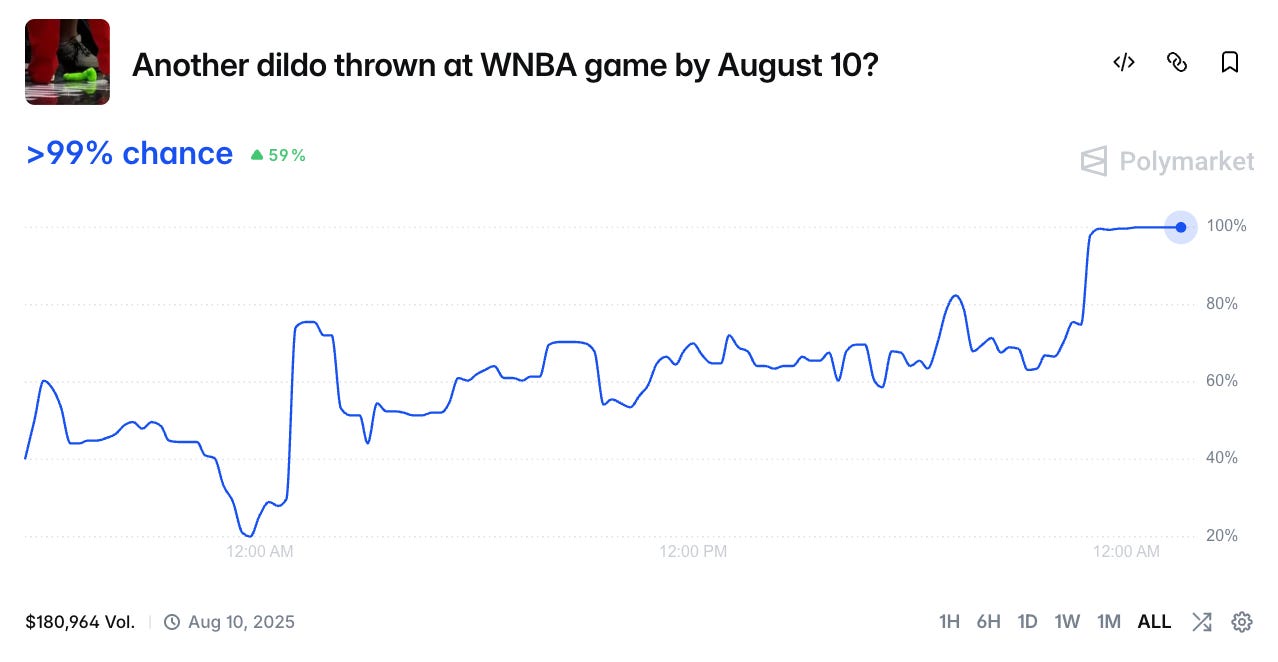
Here below, for example, is a market that is at the exact opposite end of the spectrum. This market on dildos thrown at WNBA games was easy to manipulate, had high odds of private information (for example, I would probably know with great certainty if I was a person that intended to throw a dildo onto the court), and is remarkably useless, unless you’re an arena security guard.
On the flip side, a market like this next one, on a ceasefire in the Sudan civil war, seems strikingly important. It is also incredibly hard to manipulate, unless you intend on personally sabotaging or facilitating the ceasefire in a civil war that has claimed a million lives. If you think you have the capability to do this, you are probably a very skilled diplomat and the United Nations should reach out to you.

You’ll notice a few things.
The volume on this market (by December 31st) is super small, just $1306 dollars!
The market has been fairly stable for the last few months. It doesn’t take a lot of volume to actually get a surprisingly accurate estimate. Indeed, even well-traded play money markets like Manifold can be shockingly accurate.
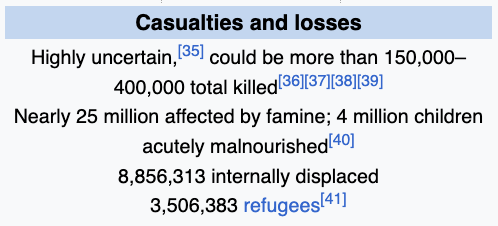
It probably deserves 100x more volume, but perhaps this is due to the media’s intense disinterest in the conflict: how often have you heard talk of the Sudanese civil war over the last few years, relative to other conflicts in the Middle East? I think the Sudanese people deserve to have more accurate crowdsourced forecasts about questions this important.
Even if it has 100x more volume, it’s hard to imagine that anyone would manipulate Sudanese politics for a couple hundred thousand dollars on Polymarket. Like I’ve said before, there are far greater real-world incentives like, say, speculating on land values in Sudan, or Emirati gold imports from Sudan.

In an ideal world, the CFTC would do the admittedly challenging work of laying out criteria for what kinds of war markets constitute the proper tradeoff between benefits and costs, and then regulating those markets to ensure compliance. There are lots of low-hanging fruit to improve these event contracts which have never been tried!5
Unfortunately, it looks like war markets are highly likely to continue to only exist outside the regulatory framework in the quasi-legal world of crypto events contracts.
Commodity Futures Trading Commission, the US body which regulates prediction markets.
Except on Manifold, where due to the flexibility of play money, conditional markets are facile to implement. There has been a thriving ecology of markets of the form “conditional on winning the primary, will X win the general election,” and “conditional on X winning the election, will Y happen.” I cannot overstate how useful these could be if some of the incentive structures around them could be properly implemented with real money markets!
As an aside, the media frequently makes vague accusations of insider trading when in fact it’s not insiders but just well informed traders using open-source intelligence and their brains. Often, the reasons to assume insiders are based in a poor understanding of how prediction markets work. For example, “new accounts” are very often just new wallets opened by seasoned traders to avoid people copying their trades. Articles often assert that a string of accurate forecasts couldn’t happen by chance, while ignoring that the same accounts also made other strings of inaccurate forecasts. If you bet on hundreds of markets, it’s very possible to win a few at long odds, while losing many others.
This is actually a super complicated question that is worthy of its own full blog post. And would you believe me if I told you I have a draft of that blog post almost ready to send out? Basically, most of these accuracy metrics are easily manipulated to tell whatever story the author wants, unfortunately. But you can still use them intelligently and in good faith if you try hard enough.
You could close markets early, in advance of the resolution date, as Manifold markets often do. You could use probabilistic resolutions where the chance of a YES resolution increases smoothly with some numerical metric (like the number of days with strikes in a given month), rather than having a YES/NO outcome hinge on a single strike’s tabulation in some niche spreadsheet. You could have market resolutions that are voted on by a trusted panel, in the spirit of the market. Endless possibilities for innovation here.
> Would Putin have invaded Ukraine if a prediction market had shown 70% odds that conditional on an invasion, Russia would fail to depose Zelenskyy after five years?
I guess your point with this example is that the common knowledge prior to the invasion was that it would likely be a success for Putin, and that prediction markets might have been more accurate about the invasion being a failure.
But mightn't there also be cases where more accurate military information would let a dictator know they actually have a *better* chance of success in their evil actions? I would tend to assume that dictators are generally less well-informed than the leaders of free nations, so maybe the question here is whether better information differentially benefits leaders who shouldn't have it.
I kinda thought Metaculus was putting everyone's forecast into some kind of ensemble model that corrected for bias. It seems like they should be able to fix that calibration. I guess the calibration itself could be biased for instance if events that resolve earlier are more likely to be YES.