
Disclaimer: I’m not a virologist, this is not health advice, read on at your own peril
1. Birder slander
By the time most people became aware of the hantavirus outbreak aboard the MV Hondius, an origin theory had already calcified in the eyes of the public.
For those that have not been following the saga, several cruise ship passengers have become sick with the Andes virus, a rare and deadly type of hantavirus, while traveling from the southern tip of South America to a collection of remote islands. The first of these passengers to fall ill was a 70-year old Dutch man traveling with his wife; both of them have since succumbed to their infection. Many of the other patients have been scattered across the world, causing global angst. Fortunately, it appears extremely unlikely that this outbreak has any pandemic potential. Unfortunately, it also appears that humanity did not learn any lessons from our previous pandemic, and were this disease a bit more conducive to spreading, we might be in big trouble.
Okay, back to my (conspiracy) theory. The WHO has put out three formal reports on the outbreak, dating from May 4th, 8th, and 13th. The one from May 4th hinted that a Dutch couple, representing the first and second cases aboard the Hondius, had traveled widely across South America before boarding, and the May 8th and 13th reports expanded on this to arrive at their working hypothesis:
Based on currently available information, the working hypothesis is that the first case acquired the infection prior to boarding the cruise, through exposure on land. Investigations are ongoing to elucidate the potential circumstances of exposure and the source of the outbreak, in collaboration with authorities in Argentina and Chile. Current evidence suggests subsequent human-to-human transmission onboard the ship. This is also supported by a preliminary analysis of the sequences, which show a close, near-identical sequenced from different cases.
I agree that this is a very plausible working hypothesis for the WHO to have! But there are a few problems with this pathway that point to the possibility of an alternate etiology:
The couple had been well outside the conventional range of the Andes virus for at least 4 weeks prior to boarding the ship, and while it’s possible to show symptoms ~5-6 weeks after exposure, this would definitely be on the longer side of an incubation period for the Andes virus. They’d actually been in Uruguay between March 13-27, then traveling to Ushuaia before boarding on April 1st (the man began showing symptoms on April 6th). And they’d only been in areas that are “confirmed” to be endemic for the Andes strain of hantavirus back in January and February. Conditional on this hypothesis being correct, it would also imply that all the other passengers that contracted the Andes virus on the ship had it progress way faster than the first case, which is slightly odd.
We still have seen zero confirmed human-to-human transmission off of the ship during this outbreak. The evidence for H2H transmission on the ship still strikes me as somewhat speculative, since it’s not possible to rule out at this stage that all the cases on the ship could have an origin on the ship itself. Much more on this later.
The near-identical sequencing data isn’t actually great evidence in favor of human-to-human transmission over other pathways, such as each of the cases becoming sick from a single non-human origin. It does rule out really silly ideas like “perhaps each of these people got hantavirus on land in a different location” or whatever, but no one was seriously considering that as an option.
Despite this outbreak being the fault of no one, it still seems to be in no one’s interest to be “responsible” for the origin of this outbreak. Unsurprisingly, Argentinian authorities are trying to place the blame on the Dutch couple’s travels in Chile, Chile is trying to place the blame on their travels in Argentina, and the city of Ushuaia, the “Southernmost City in the World,” is claiming that no hantavirus has ever been discovered there. One particular article from NBC is an iconic example of the various motivations that relevant stakeholders in this outbreak have to deflect blame:
Esteban Daniels, a birding guide in Ushuaia, said the landfill attracts eye-catching birds… not the hantavirus.
“I believe we are facing a smear campaign against this destination,” he added.
The birders in particular don’t want you to think that hantavirus can be contracted while performing their hobby. Early reports seemed to indicate that it was likely that the Dutch couple contracted hantavirus while birding on a landfill outside Ushuaia. Only problem? Well, they might not have even been birding there:
Daniels said he guided some of the ship’s birding passengers at the landfill in the days before it left for multiple South Atlantic destinations, though he said the couple that died was not among them.
This article also contains some gratuitous birder/Ushuaia propaganda for absolutely no reason:
“South America has more bird species than any other continent, and Argentina is a superb destination for birders,” he [Noah Stryker] said by email. “Ushuaia is surrounded by beautiful beech forests and snow-capped mountains, with Tierra del Fuego National Park just outside the city. Birders hope to find Magellanic Woodpeckers and White-bellied Seedsnipes there, among other specialties.”
Finally, the cruise ship industry, and the operators of the MV Hondius in particular, would very much not like anyone to consider the possibility that the cruise ship itself could have contained the source of the outbreak.
“The safety measures and hygiene measures on that ship were just simply impeccable, and they were so strict about everything,” he said in an interview. “Every time we got off the ship and we came back on, we would have to disinfect everything, all of our gear, you know, all of our boots, all of even our hiking sticks, would have to be disinfected.”
That process involved their items being sprayed down and a manual examination with brushes “to make sure that there are no stones and eggs like, you know, inside your boots inside your jacket,” Sadasivan said…
During one inspection, Sadasivan said, “my boot had this little stone in between the threads of the boot. And the person who was inspecting all of our gear made me take it back and get disinfected again, because she was saying that that little stone could contain something that causes disease.”
Alright, yes, I’m sure the ship maintained all appropriate levels of hygiene. But like… ships can have rats sometimes. What if rats or rat excreta on the ship had started this outbreak, rather than exogenous spread from the Dutch couple? Had anyone tried to research this possibility seriously? It turns out, not really.
2. It’s time for some geography
I wanted to figure out where the MV Hondius had previously traveled, but no one had actually reported on this, shockingly, so I used the Wayback Machine to find archived screenshots of the MV Hondius’ itinerary from late last year and early this year:


That final cruise is the voyage that the hantavirus outbreak took place on. When I looked this itinerary up, I was kind of hoping I’d find some neat smoking gun like “the MV Hondius had previously done a 12-week expedition up and down the coast of Chile, stopping at 10 cities.”
But no, this ship primarily travels to and from Antarctica with passengers, using Ushuaia as a home base. The internet and various cited experts seem to have been claiming a couple things that would preclude a ship that has primarily docked in Ushuaia for the last year from having contracted an infestation of hantavirus-carrying rats.
The animal that transmits the Andes virus, the long-tailed pygmy rice rat Oligoryzomys longicaudatus, which I will henceforth refer to by the much cuter name, the “colilargo,” is not found as far south as Ushuaia.
The Andes virus itself is not found as far south as Ushuaia.
Unfortunately, both of these claims seem to be complete bullshit.
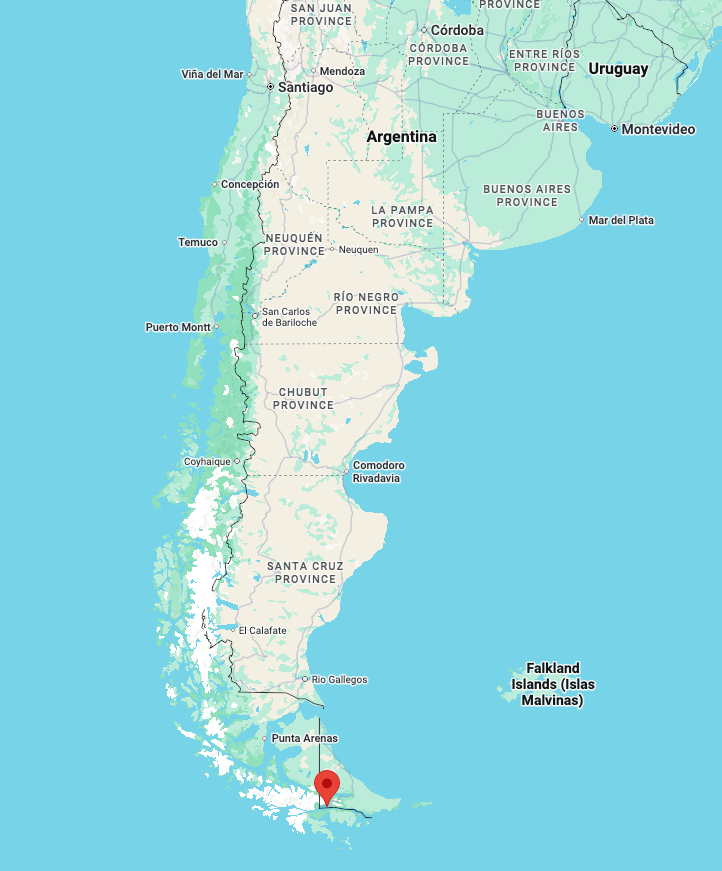
First, let’s look at the range of the colilargo. Here is Ushuaia, in Tierra del Fuego, demarcated with a beautiful red Google maps pin:
And here is the range of the colilargo as shown on Wikipedia, which is my best guess at how this bizarre misinformation has been propagated:
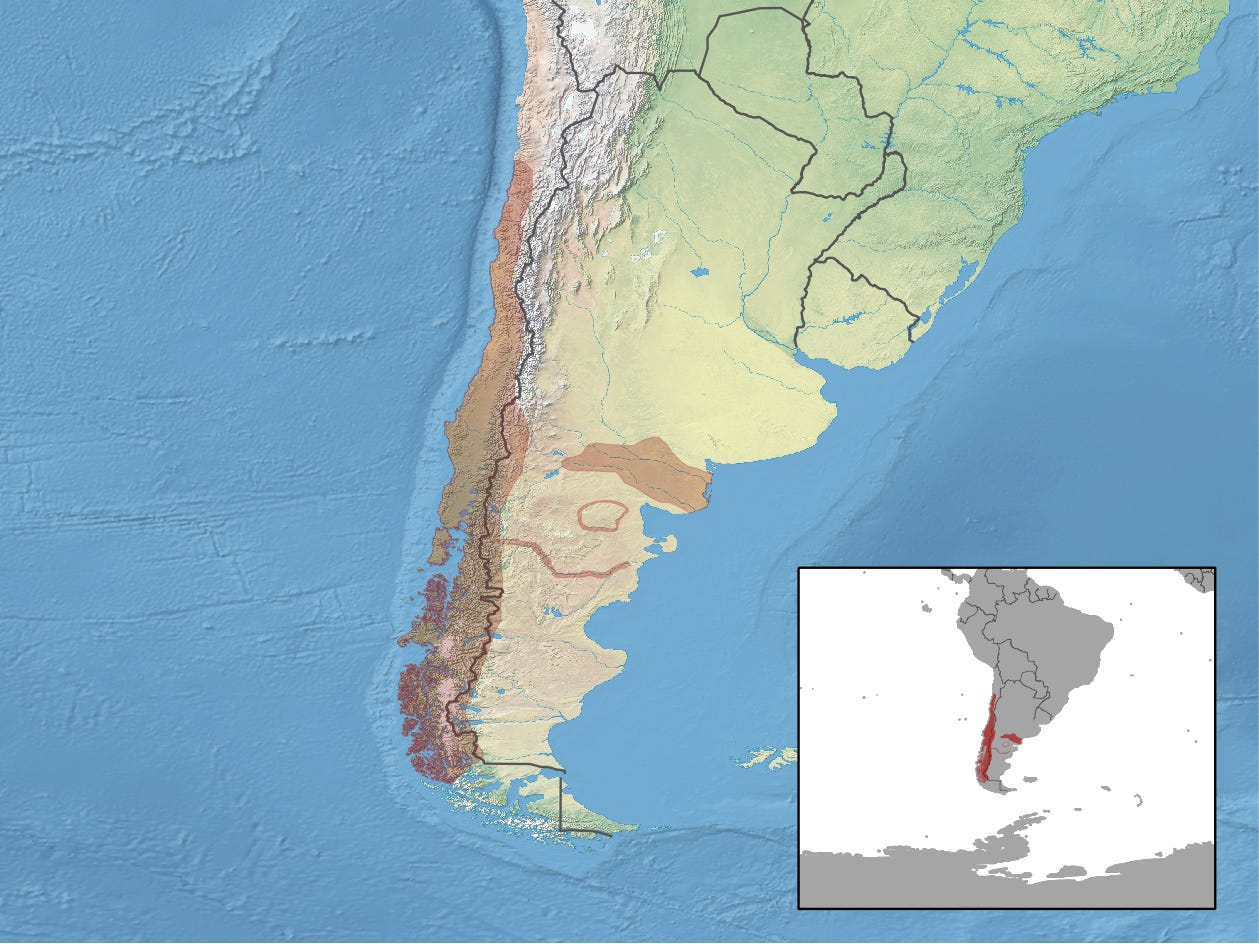
You’ll notice that it stops short of Ushuaia. However, I have no idea how the creators of this map arrived at its production. I was able to find a paper from 2012 that had sampled colilargo populations as far south as the island immediately to the south of Ushuaia, as well as the mainland just west of Ushuaia itself. On the figure below, taken from Palma, et al., the blue numbers represent colilargo locations. These extend well below the Wikipedia figure’s range.
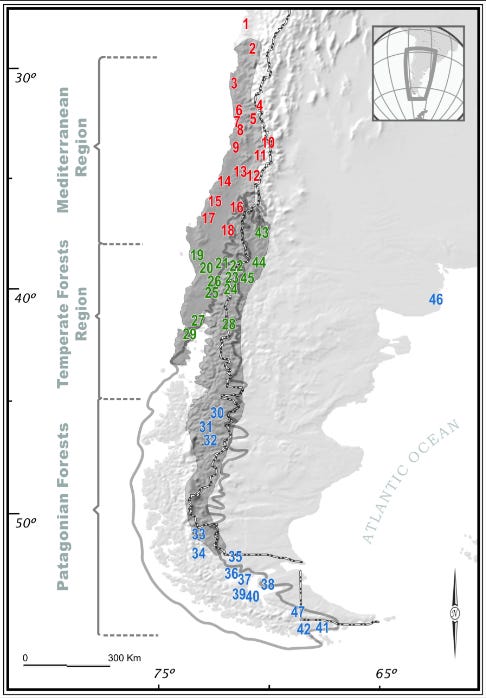
Despite what some sources will tell you about the range of the colilargo, it does in fact seem to extend to coastal areas as well, not just highland forests, and despite not being truly commensal in the same way that most ship rats are, they will exhibit peridomestic behavior, going into human structures in rural areas under certain conditions.
That is to say, I don’t think it’s totally unreasonable that there are colilargos living in Ushuaia, and that they might board a ship. It also seems plausible that the Dutch couple could have contracted hantavirus at any point while staying on land in Ushuaia as well!
Next, let’s consider the second claim, that the Andes virus reservoir lies far to the north, making it unlikely to be in rats living around Ushuaia.
Muddying the waters is the fact that the four major previous Andes virus outbreaks all occurred in a more narrow zone farther to the North, along the border between Argentina and Chile. But this is still a pretty reasonable geographic spread, and it’s hard to conclude from such a small sample size of outbreaks what the maximal extent of Andes virus outbreaks with H2H spread might be. The distance between the most southern previous outbreak and Ushuaia is roughly twice the distance between the most southern and most northern previous outbreaks. Is this a lot? That depends on your priors.
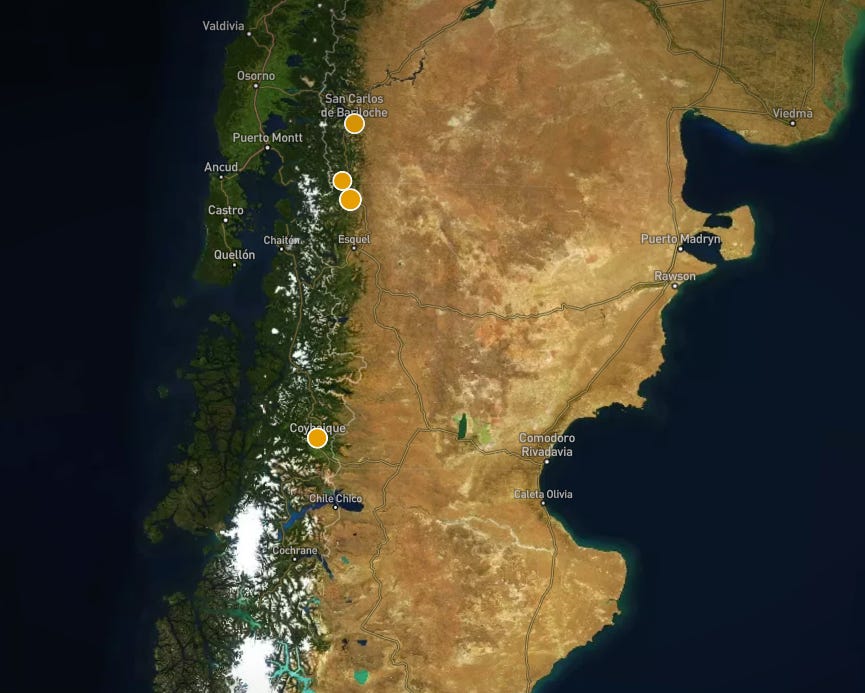
Additionally, there are plenty of other documented Andes virus cases without H2H spread or outbreaks, that might give a better estimate of the range of the virus. One paper from 2014 tried to estimate the risk of Andes virus across Argentina using species distribution modeling coupled with GIS techniques. Here were their results:
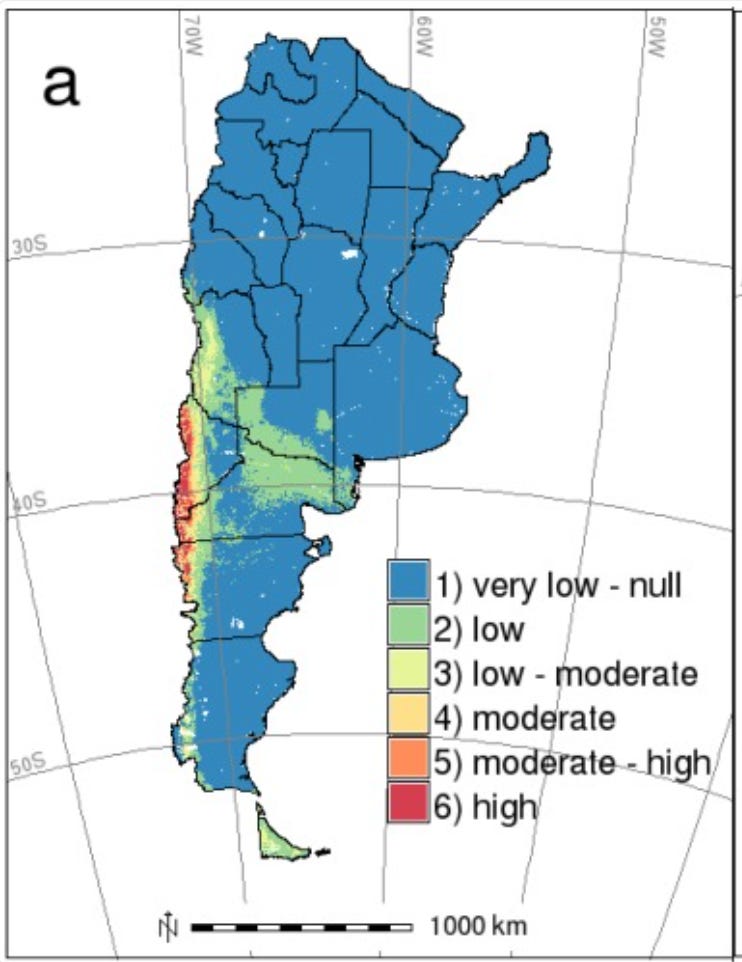
You’ll notice that there is a small patch of “low-moderate” risk down in Ushuaia:

Ultimately, I don’t have a ton of confidence in the approach of this model. They didn’t actually identify any explicit cases in that region, as far as I could tell from my read of the paper, but it factored in some combination of GIS parameters, the range of the colilargo, and the existing distribution of cases over some time period to extrapolate this from sparse data.
Another study from 2018 also seems to provide evidence that Andes virus could be chilling down in Ushuaia. Here’s a projection of the range of seropositive rodents that could contain Andes virus, which has Ushuaia just barely outside the orange likely range, and also has several other maps with different correlates which do in fact encompass Ushuaia.
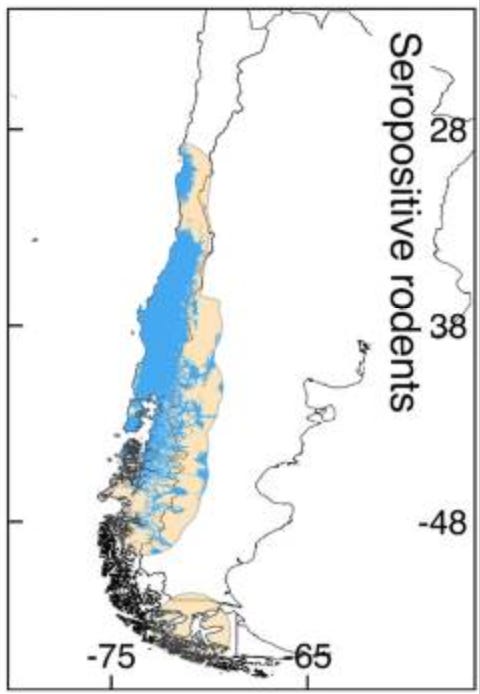
Okay, now that we’re all tired of seeing maps of Patagonia, I think we’ve clearly established that it’s absolutely possible for there to be Andes virus in Ushuaia, and I think it’s borderline journalistic/scientific malpractice for someone to confidently proclaim that such a thing would be impossible.
Just to be clear though, there haven’t been previous documented cases of Andes virus in Tierra del Fuego’s Isla Grande, where Ushuaia is, but there has in fact been at least one documented case in the immediate province to the north, Santa Cruz, albeit several hundred kilometers away. There was also supposedly a Chilean ministry report from earlier this year that documented cases much closer to Ushuaia from just months before the current outbreak in the neighboring Chilean region of Magallanes. This seemed like an important lead. Unfortunately, the Chilean ministry of health is annoyed at Americans snooping into their business.

So I used a Chilean VPN to evade them.

And after some site navigation and getting annoyed at myself for forgetting how to read Spanish, I found this table:
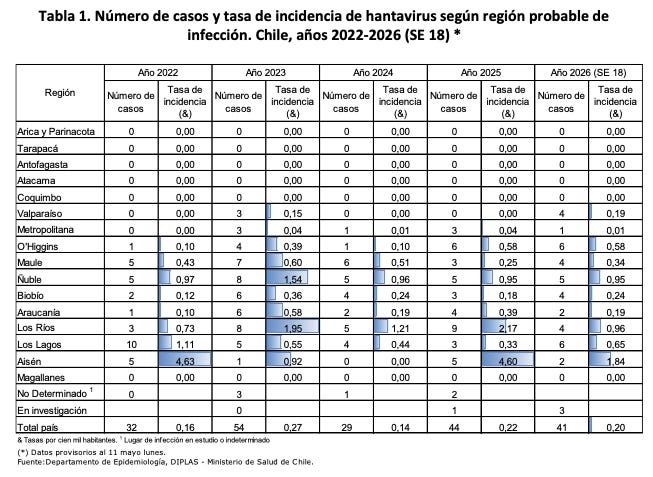
So no, zero cases in Magallanes. But there were actually a fairly high number of cases in the region immediately to the north, Aysén, which is also quite sparsely populated and lies moderately southward of the “core” Andes virus reservoir.
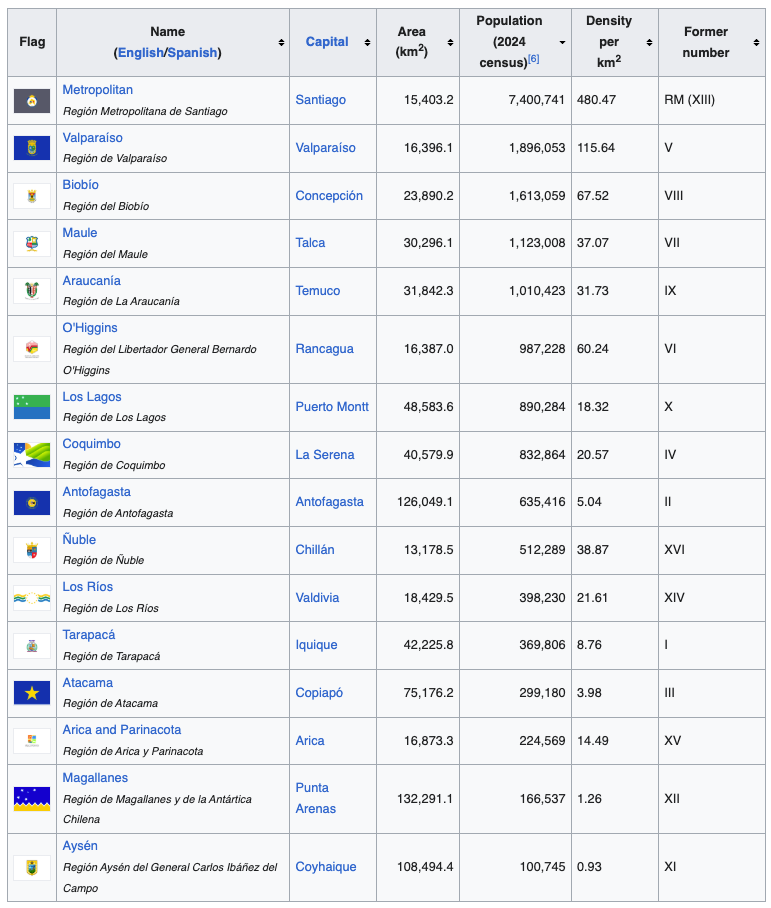
If you live in Aysén your odds of contracting Andes virus appear to be something like 3 in 100k per year. There’s also only like 1 person per sq km, so maybe everyone is really lonely and outside playing with the cute colilargos they find frolicking in the beautiful Chilean hinterlands.
3. Picking holes in my theory
Okay, so I hope by now you have an alternative hypothesis in your mind.
A colilargo, among which the Andes virus is endemic, got onboard the MV Hondius at some point during its many docking stops in Ushuaia in late 2025 and early 2026. They would have had plenty of time to do so across several seasons and are known to be peridomestic. The colilargo (or perhaps several) left droppings/urine/saliva on the ship and a bunch of people got sick based on exposure/proximity to these droppings, first the Dutch couple and then others. This could have happened in a variety of ways, perhaps even through droppings left in vents/ducts/food supplies/etc, and would be hard to distinguish from H2H spread in certain scenarios. Since there has been no documented H2H spread since people have left the ship, this could mean that actually no H2H spread has occurred at all, and the primary vector of transmission was simply exposure to rat droppings on the ship.
Now, I actually think there’s a decent chance of similar scenarios to this one as well.
The colilargo population in/near Ushuaia could have spread Andes virus to normal port rats which are more liable to go on ships, which then transmitted it to humans. The port rats might have died out quickly in this scenario but that didn’t matter because they didn’t need to sustain a reservoir of the virus for longer than a few weeks!
The Dutch husband (patient zero) could have contracted Andes virus while waiting to board in Ushuaia.
Someone who was traveling elsewhere in the region could somehow have snuck a colilargo aboard in their luggage. You might laugh, but this is how rats have gotten to all kinds of weird places, historically! Colilargos are pretty small, typically with bodies around 3-4 inches long.
Okay, while I think that my alternate origin hypothesis is possible, I haven’t quite drunk to the bottom of the kool-aid of my own conspiracy theory. There are a few pieces of evidence pushing in the direction of the consensus hypothesis from the WHO.
In past outbreaks, human-to-human spread seems pretty unequivocal. There has been active debate online about the extent of it. For example, some people seem to think that the famous birthday party spread during the Epuyen outbreak in 2018 might have actually just been a single spreading event from rat droppings, rather than H2H spread. But there have been healthcare workers who have contracted it while caring for patients, which seems pretty indisputable. But H2H spread could still be rarer than we think it is, which is already pretty rare, for the Andes virus. If H2H spread is well-documented though, then that seems perhaps more plausible on a cruise ship than a bunch of ppl getting exposed to some out-of-its-domain colilargo.
The consensus WHO theory implies that the Dutch patient zero would have been incubating the virus for ~6 weeks, from when he was in the core Andes virus range in late February to when he started showing symptoms on April 6th. That’s on the longer side, but my theory implies that they would have contracted it as soon as getting on the ship and then showed symptoms within 6 days. That’s very much on the shorter side. I’ve seen different numbers thrown about, but 4-42 days seems like a reasonable amount. So this would definitely be pushing the shorter end. On the other hand, since there have now been about a dozen cases contracted on the ship, a lower bound outlier seems likely! But it also seems unlikely that someone would contract it so soon after stepping onto the ship.
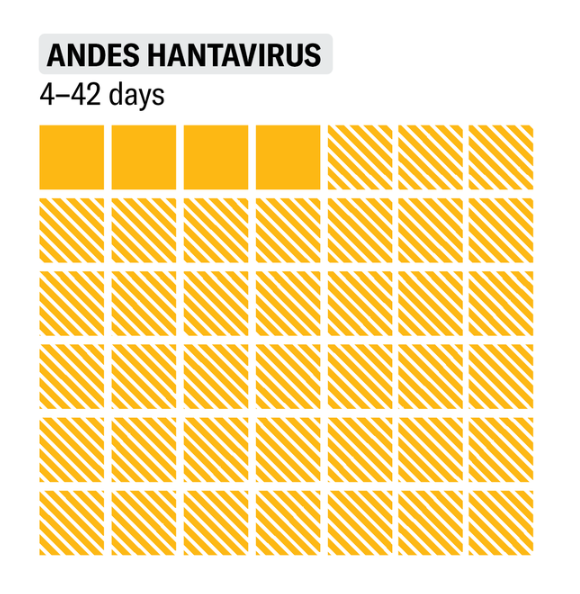
Figure clipped from a Scientific American graphic by Amanda Montañez; Source: Cleveland Clinic, U.S. Centers for Disease Control and Prevention (data). https://www.scientificamerican.com/article/why-hantavirus-takes-so-long-to-show-symptoms-and-what-that-means-for-containment/ The WHO likely has access to specific details about the spread on the ship and its timeline, and who am I, who doesn’t really know much about virology or epidemiology, to think I could guess better at the origin of such an outbreak? They might have good evidence about the physical location of cases on the ship, or which passengers might have been sharing saliva. They also could have collected viral samples from around the ship, scoured it for rats, or done any number of things to rule out my hypothesis. I really hope someone from the WHO reads this article and debunks my harebrained theory!
Cruise ships maintain that there are never any rats aboard their vessels. I’ve found tons of articles online claiming that rats are no longer an issue on cruise ships due to modern sanitation, trapping, and poisoning practices, as well as various international anti-rat measures that ships take, such as rat-guards on the ropes that ships use to moor. I think this is actually pretty strong evidence against my theory! That being said, I’m not entirely convinced. Skepticism is warranted as of course cruise ships do not want you to think there are rats aboard! You kind of have to imagine that rats, which have managed to get into at least two apartments I have lived in, have also managed to get into a cruise ship or two, especially given the strong evolutionary incentives in getting to be the first rat of your genus going to some remote island in the Atlantic. That’s gotta be the best feeling in the world if you’re a rat (only half joking).
A lack of off-ship H2H spread doesn’t necessarily indicate that no on-ship H2H spread occurred. Since the discovery that this is indeed the Andes virus, I’m sure that everyone has been taking pretty good precautionary measures. Despite a couple random insane people that left the ship early and then traveled to a bajillion countries because they’re extreme travelers, most people appear to have been very diligently observing quarantine, considering the severity of this disease. So it’s quite possible that if H2H spread is rare, you could still get it amid the bacchanalian conditions onboard a cruise ship, without getting it in more stringent conditions later.
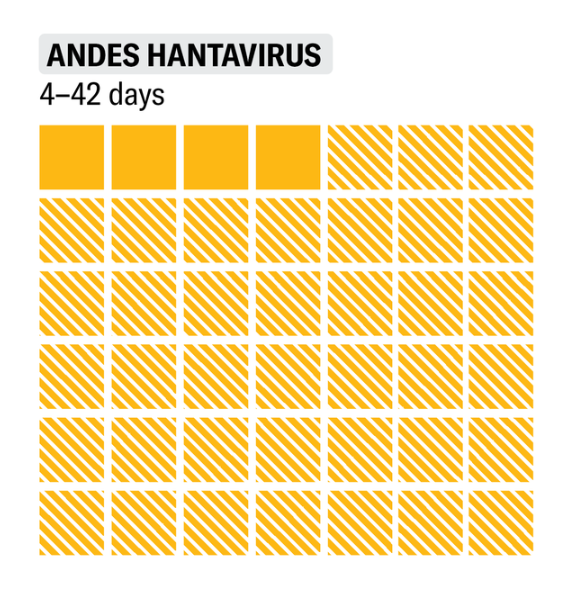
All in all, I think there’s something like a 10-20% chance that my own theory is roughly correct (that probably a colilargo but possibly another rat onboard the MV Hondius was the origin of this spillover event).
4. What do the markets think though?
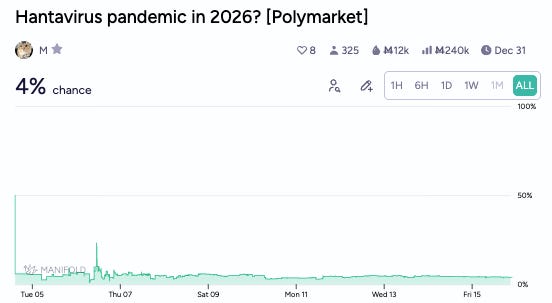
First of all, there’s very little chance of a hantavirus pandemic. Even this 4% is mostly just the discount rate of play money on Manifold. And it’ll be quite hard for there to be a pandemic if not a single non-passenger contracts hantavirus from this outbreak. Manifold traders still think there’s only about a 40% chance of this happening.

Traders also roughly agree with me that it’s possible but unlikely that the origin of the outbreak will be revealed to be from a rat on the ship. The bar for this is also kind of high, because not only does this have to be the case, but this has to be discovered, and there has to be some form of loose consensus reached. Given how slow, stubborn, and reluctant to change its mind the WHO is, this might never happen, regardless of the underlying truth of the matter. Even if the evidence shifts in the favor of such a theory, it’s possible that institutional inertia will prevent people’s minds from changing.

The WHO is way smarter than me, but they were wrong several times about important things during the COVID pandemic, to cite a recent example. They refused to acknowledge airborne spread for several months, despite being faced with overwhelmingly obvious evidence. They didn’t seriously consider a lab origin for the virus until years later. They even initially argued against the efficacy of mask use!
I think the biggest issue here is that very often, there’s cognitive anchoring on the earliest or most initially plausible theory. The WHO had strong priors that aerosol transmission was much rarer than fomite or droplet transmission, and it took a huge amount of effort to break that inertia. I hope that they have a more open mind in the future, and it’s worrisome that I haven’t seen a single health agency even contemplating the idea that a rat on the ship itself could have caused this outbreak’s spillover event. Getting these kinds of details right is important, not just for the sake of public health, but also for public confidence in their deliberative processes.
Hopefully those of you that read this entire article for a good conspiracy weren’t let down. Insofar as there would be a conspiracy to suppress this theory, it would surely have to be the Ushuaia Birding Association, who don’t want us to know that lurking in the bushes are cute but deadly Andes virus-carrying colilargos, ready to lay droppings on your shoes while you’re busy ogling a Magellanic Woodpecker.
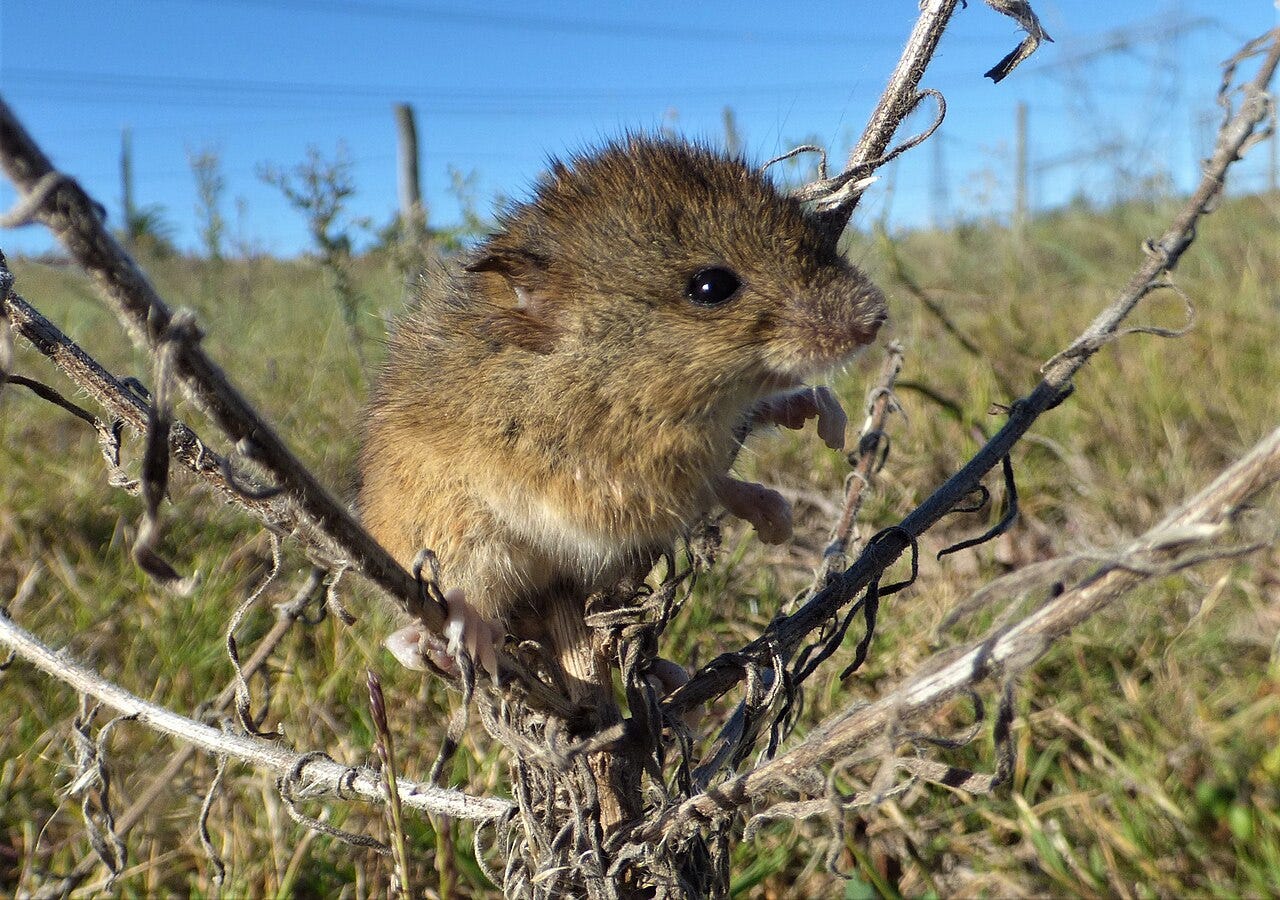
Interesting NYT piece from this morning that's relevant:
https://www.nytimes.com/2026/05/16/world/europe/hantavirus-hondius-cruise.html
Excellent research and dialogue.