
1. The Great Thing
In order to understand how Nobel Peace Prizes are awarded, you have to go back to about the first century AD. As the Romans began to insert themselves more and more into the affairs of Northern Europe, sending armies north and establishing relations with the Germanic tribes, German political institutions had to adapt. The Latins had their “public thing,” the res publica, which we are today all grateful for, and the Germans had their “things” as well, assemblies of men to deliberate affairs with ever-greater formality and cohesion as time went on. We know this because one of the surviving texts of the great historian, Tacitus, is his ethnography of the German peoples lying to the north of the Roman Empire.
It’s not simple to draw a throughline from the republican institutions of the classical era to the cradle of democratic governance at the start of the Viking Age, but by the time that commerce had reemerged in the North Sea and the Mediterranean in the tenth century, there were lots of “things.” Today’s Althingi (general thing) in Iceland, Folketing (people’s thing) in Denmark, and Storting (great thing) in Norway are descendants of these assemblies.
The ancient Frisians and Marcomanni and Varangians would be pleased to learn that the Storting, the legislature of Norway, has a tremendously potent soft power tool at its disposal, far more potent than arranged marriages, hostage-exchange, and the arrangement of feasts. It appoints the members of the Norwegian Nobel Committee, the body that selects perhaps the most prestigious prize in the world: the Nobel Peace Prize.
When you think of Norway, and when you think of the Nobel Peace Prize, probably a few things come to mind. You’re probably imagining Scandinavian democratic socialism and a tendency to honor high-minded, left-leaning institutions and individuals. You’re probably remembering how Barack Obama got the prize in 2009 just months into office, or how the European Union received the prize in 2012.
However, you’d be wrong. Unlike the large bodies that select the other Nobel prizes like the Swedish Academy of the Sciences or the Nobel Assembly at Karolinska Institute, which are selected without tight, central, political control, the Norwegian Nobel Committee is small, agile, and appointed by the Storting with an eye (consciously or not) towards furthering Norwegian interests.
And what are these Norwegian interests? Primarily, anything that hurts Russia helps Norway. Norway is a primary rival of Russia in provisioning energy to Europe and in controlling the “High North,” and you shouldn’t forget that they share a border. Norway is a NATO partner and a fear of Russia occupies the public consciousness to a greater extent than you might think. Remember that the most famous piece of art to come out of Norway in recent memory has been a TV series in which Russia occupies the country.
Secondly, Norway and their sovereign wealth fund are deeply interested in stable global affairs. Peace and the spread of democratic institutions are beneficial to this, but so are economic conditions that allow integration between Norway and the EU, as well as more far-flung trading partners. While many countries ostensibly have “global peace” as a goal, there are specific economic factors that lead Norway to have an actual vested interest in peace.
It is with this framing that we can begin to understand why the Nobel Committee selects who they do.
2. The Committee Members
Here are the five members of the Norwegian Nobel Committee, the body that selects the Peace Prize laureates each year, along with my description of their general political alignment:
Anne Enger: center-right, known most for her opposition to EU membership and abortion, she once served as briefly as the acting prime minister.
Asle Toje: a “neo-classical realist,” conservative political scholar, not a fan of the international liberal order.
Kristin Clemet: conservative politician and economist, but perhaps a foil of Toje’s in that she is a fan of the international liberal order.
Gry Larsen: labour party politician, involved with left-leaning NGOs.
Jørgen Watne Frydnes: the chair of the committee, led a free expression NGO in Norway and was heavily involved in global human rights work and supporting the Utøya community in the aftermath of the 22/7 attacks.
We have three members here that are fairly unambiguously conservative in one form or another (Enger, Toje, and Clemet). Larsen is fairly unambiguously left-leaning. And then Frydnes, the chair, could probably be described as the centrist of the bunch.
The governments that appointed them line up quite neatly with this characterization. The Storting is currently ruled by a center-left coalition, under which Larsen was appointed. But in 2021 and prior, when Enger, Toje, Clemet, and Frydnes were appointed, there was a conservative-led government in power. Toje was also re-appointed under the current government, somehow (impressive levels of non-partisanship in Norway)!
The result is that you would expect this committee, which has been more or less under its current political alignment since Frydnes and Clemet’s appointments in 2021, to represent in its consensus a broadly center-right, Norwegian vision for global peace and the advancement of Norwegian interests.
3. Forecasting the Prize
Here’s the graph for the last month of a very liquid market with $21 million in volume trying to forecast the recipient of the Nobel Peace Prize.
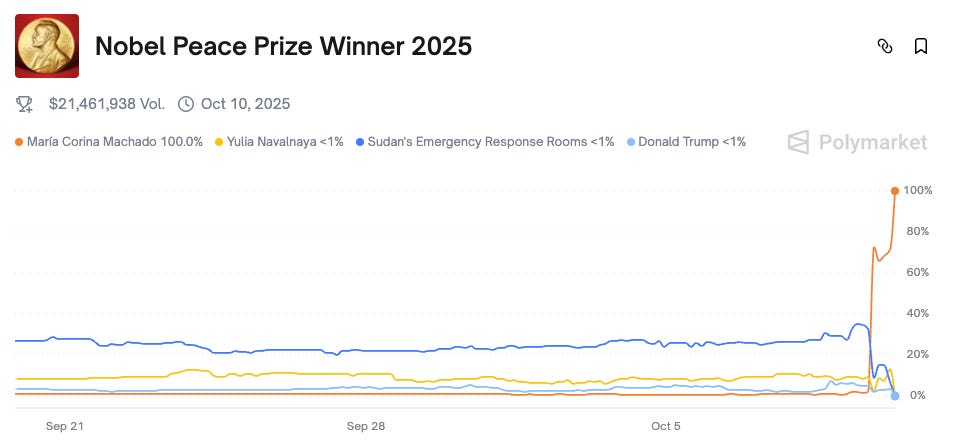
Ignore the last 12 hours, where some degenerate gambler managed to read the tea leaves through bad Wordpress website OPSEC from the Nobel Committee. It appears that they likely saw that someone had very recently updated the profile picture for Maria Machado, and rightly took that to mean that they were preparing a press release for the next morning. Oops.
Before then, you had Donald Trump at about 4%, Sudan’s Emergency Response Rooms at about 30%, and Yulia Navalnaya at about 10% for most of the final month. And Maria Machado was a rounding error, sitting at below 1%.
So, why then was Machado selected? I’d argue this is because the Nobel Committee has become much more aggressive of late in trying to make regime change (1) happen and (2) go well.
Let’s look at the few years of recipients since 2021, when the current iteration of consensus selections in the committee began (at least, 4 out of 5 members, not including Larsen).
2021: Maria Ressa and Dmitry Muratov. Ressa was a journalist and loud critic of the Duterte regime in the Philippines; this was awarded at a time when it appeared that Duterte was consolidating autocratic levels of power and might attempt to hold onto power after the election the following year. Muratov was editor-in-chief of Novaya Gazeta, the one free-ish newspaper in Russia, and loud critic of the Putin regime.
2022: Ales Bialiatsky, key opposition figure to the dictator of Belarus, Lukashenko, alongside the human rights organizations Memorial (Russia) and Centre for Civil Liberties (Ukraine). This was awarded months after the invasion of Ukraine by Russia, with the support of Lukashenko.
2023: Narges Mohammadi, Iranian women’s rights leader and political dissident. This was awarded in light of rising political dissent in Iran.
2024: Nihon Hidankyo, Japanese anti-nuclear (weapons, not energy) organization.
2025: Maria Corina Machado, Venezuelan opposition leader. This prize was awarded in light of a loosening of Maduro’s hold on power in Venezuela, and as the US pursues active regime change tactics against the Venezuelan government.
Okay, nice, now what can we learn from these 5 years of selections. Well, four out of five selections pursue the following two goals that should be heavily predictable from what we know about Norwegian foreign policy.
Opposing Russia
Pursuing regime change away from autocracies
The selection of Muratov in 2021, three anti-Lukashenko/Putin/Russia people or organizations in 2022, and dissidents/opposition leaders in Iran and Venezuela who would undermine the alliance between Russia and those two nations in 2023 and 2025 very clearly fit both of these goals.
Nihon Hidankyo’s selection in 2024 would be a bit of a stretch as anti-Russian policy, I’ll concede, but in a post-Cold War era, much of Russia’s power comes from its nuclear arsenal. Rising global attention to disarmament treaties would renew attention to this dynamic and if successful, could diminish Russia’s hold on international affairs. Of course, this is probably also a “typical” selection in that rewards a peace-oriented organization that has been working nobly since the 1950s towards this goal. I’m not really going to claim that this paradigm could have forecasted the 2024 selection.
But, I do think it could have been strongly predictive of the Peace Prize selection this year. If you were looking for someone who broadly ticked the boxes of “regime change away from autocracies” and “would damage Russian foreign interests,” you basically have only Machado and Navalnaya. Navalnaya, to forecasters’ credit, was at 10%, but also you have to remember, the Nobel Committee is smart.
4. The Nobel Committee is Smart
Navalnaya, Russian opposition leader in exile, and widow of Alexei Navalny, Russia’s former opposition leader in exile, would have been a fairly repetitive selection, given the 2021 and 2022 selections. It’s also not really clear to me that lending credence to her opposition to Putin would really do that much at this point to further anti-Putin sentiment among the Russian public or leadership. To the extent that the selection should actually further the goals of the Norwegian Nobel Committee, rather than just awarding someone who shares those goals, Navalnaya would not have been a great laureate.
Machado was a very savvy selection, on the other hand. Let’s say that Maduro is in fact removed from power in Venezuela. This is surprisingly not that unlikely. Markets currently give about 20% odds to this happening within this calendar year, and I think if there were a market on whether this would occur within the next couple years, it would probably be around 50%, if not higher. If Maduro is removed from power, it’s not clear that the result would be democratic rule, versus a military junta followed by another authoritarian leader.
The selection of Machado gives a big ‘ol wreath to Machado to consolidate support in the aftermath of a military coup (see Madagascar, Oct 2025) or public uprising (see Nepal, Sep 2025). In both cases, there would be an opportunity for the anti-government forces to select Machado to lend them domestic and international credibility. The selections of Mohammadi and Bialitsky were similarly oriented. Both, especially Bialitsky, could have plausibly been selected—and perhaps, still could be—as popular leaders in the aftermath of a coup. In particular, the Nepalese discord server poll-directed selection of a leader shows how powerful acclaim of the sort that a Peace Prize would lend can be in these deliberations.
On top of this, there was an unusual dynamic that the Nobel Committee had to consider this year in particular. President Trump wanted the award badly enough to mount an international lobbying campaign at the Norwegian government to push for his selection. It’s unclear whether these efforts were fruitful, but it’s transparently obvious that Machado’s selection was probably the least offensive to the Trump administration of the many options the Nobel Committee might have been considering. Machado had previously been praised by Trump, and even Trump had to concede, after the selection, that despite the fact that he should have received it, Machado was pretty decent as well. Al Jazeera came to a similar conclusion…
By giving the award to Venezuela’s Maria Corina Machado, the Nobel Committee has effectively crowned Trump’s vision of power and intervention as ‘peace’.
…however their framing is just not as accurate. The selection was not crowning Trump’s vision, but trying to bring Trump back into the fold of encouraging a durable, pro-democracy leader in the aftermath of a potential conflict with Venezuela. Machado herself could appeal to Trump in this manner, showing a degree of craftiness that many recipients may not have exhibited.
In any case, I do think that the selection of Machado utilized the soft power of the Nobel Committee far better than the selection of a leader with a history of efforts towards world peace would have been. Selecting an opposition leader is an extremely powerful global endorsement of that figure, which could be decisive in the chance that regime change occurs. Compare this to how some of the other Nobel Prizes function, where they generally reward some sclerotic, past-their-prime scientists for their historic achievements. That’s nice, as far as prizes are concerned, and it’s the kind of selections that large, scientific bodies that appoints its own members tend to reach. But it’s not the kind of selection that would be the best use of a five-member committee of political appointees.
5. The Committee’s Strategy Has Changed
In the past, the committee did not necessarily have this current pro-regime change philosophy. Instead, the committee generally aimed to reward global leaders who pursued policies aligned with their interests, rather than rewarding individuals and organizations that sought to replace leaders who were not aligned with those interests.
For example, in the 12 years prior to the current iteration of the committee, you had the selections of 5 people or organizations who pretty clearly matched that ideology: Abiy Ahmed (2019), Juan Manuel Santos (2016), the Tunisian National Dialogue Quartet (2015), Ellen Johnson Sirleaf (2011), and Barack Obama (2009). All were rewarded under, as best as I can tell, the notion that the possibility of earning a Nobel Peace Prize might motivate leaders to pursue peaceful policies in their home countries. Interspersed between these were more “typical” selections that rewarded long-standing peace-seeking organizations like the International Campaign to Abolish Nuclear Weapons and the World Food Organization.
I think insofar as the Nobel Peace Prize exists in a political context—and it does—the Nobel Committee should be strategic about how it uses its soft power to advance goals that benefit the world. Of course, the goals it pursues will primarily benefit Norway, not the world, but lucky for the world, the things that benefit Norway are a surprisingly good proxy for the things that benefit the world. It’s not perfect, due to some of the idiosyncrasies of Norway-UN relations leading them to continue to award random prizes to various UN bodies in a way that I don’t think furthers those UN bodies’ prestige or power at all. But generally speaking, a world with diminished Russian power and democratic, Nobel-stamped leaders coming into power after regime changes in unstable autocracies is probably a good thing.
Interesting. I think rationally there's no reason to care about who gets the Nobel Peace Prize, but you make a good case that instrumentally it's good that it does get attention!
Okay, serious question. If the Noble Committee is that smart, why the heck isn't there peace?
Interesting article. It always seemed obvious that the Nobel Peace Prize was the most political of the prizes (although there are controversies and political conspiracies in the science prizes as well) but I had never thought it through in the context of Norwegian soft power. I always assumed it was just generic virtue signalling without specific goals.